Advertisements
Advertisements
Question
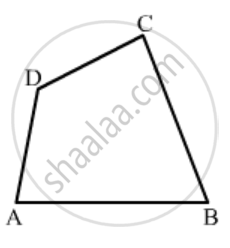
In Fig. 16.19, ABCD is a quadrilateral.
How many pairs of opposite sides are there?
Advertisements
Solution
Two
RELATED QUESTIONS
How many diagonals does following have?
A triangle
Complete of the following, so as to make a true statement:
A quadrilateral is convex if, for each side, the remaining ______ lie on the same side of the line containing the side.
Which of the following quadrilateral is not a rhombus?
The angles of a hexagon are (2x + 5)°, (3x - 5)°, (x + 40)°, (2x + 20)°, (2x + 25)° and (2x + 35)°. Find the value of x.
ABCD is a quadrilateral in which AB || DC and AD = BC. Prove that ∠A = ∠B and ∠C = ∠D.
In quadrilateral HOPE, the pairs of opposite sides are ______.
Using the information given, name the right angles in part of figure:
AC ⊥ BD

Using the information given, name the right angles in part of figure:
AC ⊥ CD

Can we have two obtuse angles whose sum is a reflex angle? Why or why not?
How many points are required to form a quadrilateral?
