Advertisements
Advertisements
Question
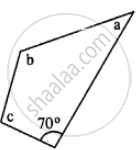
In the given figure : ∠b = 2a + 15 and ∠c = 3a + 5; find the values of b and c.
Advertisements
Solution
∵ Sum of angles of quadrilateral = 360°
70° + a + 2a + 15 + 3a + 5 = 360°
6a + 90° = 360°
6a = 270°
a = 45°
∴ b = 2a + 15 = 2 x 45 + 15 = 105°
c = 3a + 5 = 3 x 45 + 5 = 140°
Hence ∠b and ∠c are 105° and 140°
RELATED QUESTIONS
How many diagonals does following have?
A convex quadrilateral
How many diagonals does following have?
A triangle
In a quadrilateral, define of the following Adjacent sides .
In a quadrilateral, define of the following Interior .
Complete of the following, so as to make a true statement:
The measure of each angle of a convex quadrilateral is ..... 180°.
Complete of the following, so as to make a true statement:
A point is in the interior of a convex quadrilateral, if it is in the ..... of its two opposite angles.
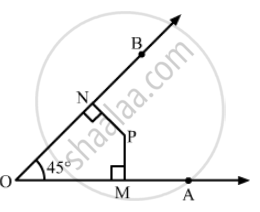
In Fig. 16.20, find the measure of ∠MPN.
Two opposite angles of a parallelogram are 100° each. Find each of the other two opposite angles.
In parallelogram ABCD, its diagonals intersect at point O. If OA = 6 cm and OB = 7.5 cm, find the length of AC and BD.
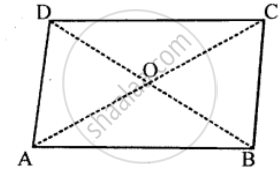
Write, giving reason, the name of the figure drawn alongside. Under what condition will this figure be a square.
Find the angles of a quadrilateral whose angles are in the ratio 1: 4: 5: 2.
In the quadrilateral ABCD, AB = BC and AD = DC Measure of ∠BCD is
If angles A, B, C and D of the quadrilateral ABCD, taken in order, are in the ratio 3 : 7 : 6 : 4, then ABCD is a ______.
If APB and CQD are two parallel lines, then the bisectors of the angles APQ, BPQ, CQP and PQD form ______.
If the sum of two angles is greater than 180°, then which of the following is not possible for the two angles?
Number of angles less than 180° in the following figure is ______ and their names are ______.

In the following figure, What is BD – BE?

Using the information given, name the right angles in part of figure:
RS ⊥ RW

Draw a rough sketch of a quadrilateral PQRS. Draw its diagonals. Name them. Is the meeting point of the diagonals in the interior or exterior of the quadrilateral?