Advertisements
Advertisements
Question
Three angles of a quadrilateral are equal. If the fourth angle is 69°; find the measure of equal angles.
Advertisements
Solution
Let each equal angle be x°
x + x + x + 69° = 360°
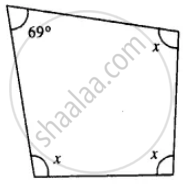
3x = 360°- 69
3x = 291
x = 97°
Each, equal angle = 97°
RELATED QUESTIONS
The perimeter of a parallelogram is 22 cm . If the longer side measures 6.5 cm what is the measure of the shorter side?
ABCD is a parallelogram, AD is produced to E so that DE = DC and EC produced meets AB produced in F. Prove that BF = BC.
Complete of the following, so as to make a true statement:
A quadrilateral has ..... vertices, no three of which are .....
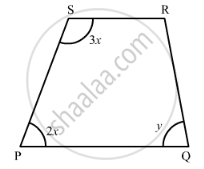
In the given figure, PQRS is an isosceles trapezium. Find x and y.
Complete the following statement by means of one of those given in brackets against each:
f consecutive sides of a parallelogram are equal, then it is necessarily a ..................
The consecutive sides of a quadrilateral have
Given : In quadrilateral ABCD ; ∠C = 64°, ∠D = ∠C – 8° ; ∠A = 5(a+2)° and ∠B = 2(2a+7)°.
Calculate ∠A.
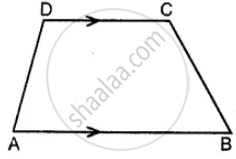
The following figure shows a quadrilateral in which sides AB and DC are parallel. If ∠A : ∠D = 4 : 5, ∠B = (3x – 15)° and ∠C = (4x + 20)°, find each angle of the quadrilateral ABCD.
ABCDE is a regular pentagon. The bisector of angle A of the pentagon meets the side CD in point M. Show that ∠AMC = 90°.
The angles A, B, C and D of a quadrilateral are in the ratio 2 : 3 : 2 : 3. Show this quadrilateral is a parallelogram.
Which of the following is not true for a parallelogram?
In quadrilateral WXYZ, the pairs of opposite angles are ______.
In the following figure, ∠XYZ cannot be written as ______.

In the following figure, if point A is shifted to point B along the ray PX such that PB = 2PA, then the measure of ∠BPY is ______.

Using the information given, name the right angles in part of figure:
AC ⊥ BD

Using the information given, name the right angles in part of figure:
AE ⊥ CE

Using the information given, name the right angles in part of figure:
AC ⊥ CD

What conclusion can be drawn from part of given figure, if DC is the bisector of ∠ADB, CA ⊥ DA and CB ⊥ DB?

Can we have two obtuse angles whose sum is a reflex angle? Why or why not?
Draw a rough sketch of a quadrilateral KLMN. State two pairs of opposite angles.
