Advertisements
Advertisements
प्रश्न
Three angles of a quadrilateral are equal. If the fourth angle is 69°; find the measure of equal angles.
Advertisements
उत्तर
Let each equal angle be x°
x + x + x + 69° = 360°
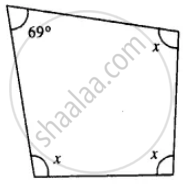
3x = 360°- 69
3x = 291
x = 97°
Each, equal angle = 97°
संबंधित प्रश्न
ABCD is a parallelogram, AD is produced to E so that DE = DC and EC produced meets AB produced in F. Prove that BF = BC.
Complete of the following, so as to make a true statement:
A quadrilateral has ...... angles.
In Fig. 16.19, ABCD is a quadrilateral.
Name a pair of adjacent sides.
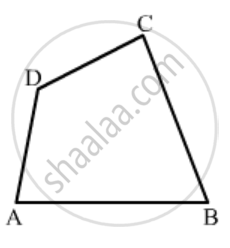
The three angles of a quadrilateral are respectively equal to 110°, 50° and 40°. Find its fourth angle.
The four angles of a quadrilateral are as 3 : 5 : 7 : 9. Find the angles.
Mark the correct alternative in each of the following:
The opposite sides of a quadrilateral have
In quadrilateral ABCD, side AB is parallel to side DC. If ∠A : ∠D = 1 : 2 and ∠C : ∠B = 4 : 5
(i) Calculate each angle of the quadrilateral.
(ii) Assign a special name to quadrilateral ABCD
Given : In quadrilateral ABCD ; ∠C = 64°, ∠D = ∠C – 8° ; ∠A = 5(a+2)° and ∠B = 2(2a+7)°.
Calculate ∠A.
Two diagonals of an isosceles trapezium are x cm and (3x – 8) cm. Find the value of x.
Observe the figure below and find out their name.
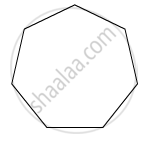
Observe the figure below and find out their name.

One angle of a pentagon is 160° and the rest are all equal angles. Find the measure of the equal angles.
Calculate the measure of each angle of a nonagon.
In the figure, PQRS and PTVS are two cyclic quadrilaterals, If ∠QRS = 100°, then ∠TVS =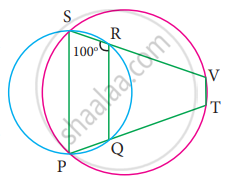
Both the pairs of opposite angles of a quadrilateral are equal and supplementary. Find the measure of each angle.
In the following figure, if point A is shifted to point B along the ray PX such that PB = 2PA, then the measure of ∠BPY is ______.

Using the information given, name the right angles in part of figure:
AC ⊥ BD

Draw a rough sketch of a quadrilateral KLMN. State two pairs of opposite sides.
