Advertisements
Advertisements
प्रश्न
Both the pairs of opposite angles of a quadrilateral are equal and supplementary. Find the measure of each angle.
Advertisements
उत्तर
Let ABCD be a quadrilateral.
So, ∠A = ∠C
∠B = ∠D
And ∠A + ∠C = 180°, ∠B + ∠D = 180°
Now, ∠A + ∠A = 180° ...[∠C = ∠A]
⇒ 2∠A = 180°
⇒ ∠A = 90°
Similarly, ∠B = 90°
Hence, each angle is a right angle.
APPEARS IN
संबंधित प्रश्न
The perimeter of a parallelogram is 22 cm . If the longer side measures 6.5 cm what is the measure of the shorter side?
Complete of the following, so as to make a true statement:
A quadrilateral has ....... sides.
Complete of the following, so as to make a true statement:
In a quadrilateral the point of intersection of the diagonals lies in .... of the quadrilateral.
Two angles of a quadrilateral are 89° and 113°. If the other two angles are equal; find the equal angles.
In an isosceles trapezium one pair of opposite sides are _____ to each Other and the other pair of opposite sides are _____ to each other.
If three angles of a quadrilateral are 90° each, show that the given quadrilateral is a rectangle.
In a pentagon ABCDE, AB || ED and ∠B = 140°, ∠C = 2x° and ∠D = 3x°. Find ∠C and ∠D
In the figure, PQRS and PTVS are two cyclic quadrilaterals, If ∠QRS = 100°, then ∠TVS =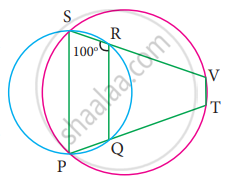
If the sum of two angles is equal to an obtuse angle, then which of the following is not possible?
The number of common points in the two angles marked in the following figure is ______.

