Advertisements
Advertisements
प्रश्न
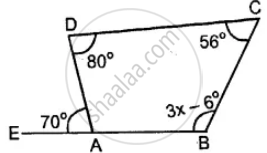
Use the information given in the following figure to find the value of x.
Advertisements
उत्तर
Take A, B, C, D as the vertices of Quadrilateral and BA is produced to E (say).
Since ∠EAD = 70°
∴ ∠DAB = 180° – 70°= 110° [EAB is a straight line and AD stands on it ∠EAD+ ∠DAB = 180°]
∴ 110° + 80° + 56° + 3x – 6° = 360°
[∵ sum of interior angles of a quadrilateral = 360°]
∴ 3x = 360° – 110° – 80° – 56° + 6°
3x = 360° – 240° = 120°
∴ x = 40°
संबंधित प्रश्न
The perimeter of a parallelogram is 22 cm . If the longer side measures 6.5 cm what is the measure of the shorter side?
In a quadrilateral, define of the following Diagonals .
Complete of the following, so as to make a true statement:
A quadrilateral has ....... sides.
Complete of the following, so as to make a true statement:
A diagonal of a quadrilateral is a line segment that joins two ...... vertices of the quadrilateral.
The four angles of a quadrilateral are as 3 : 5 : 7 : 9. Find the angles.
If the sum of the two angles of a quadrilateral is 180°. What is the sum of the remaining two angles?
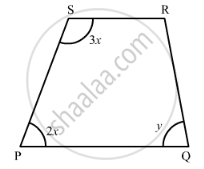
In the given figure, PQRS is an isosceles trapezium. Find x and y.
Complete the following statement by means of one of those given in brackets against each:
If both pairs of opposite sides of a quadrilateral are equal, then it is necessarily a ...............
If the bisectors of two adjacent angles A and B of a quadrilateral ABCD intersect at a point O such that ∠C + ∠D = k ∠AOB, then find the value of k.
Three angles of a quadrilateral are equal. If the fourth angle is 69°; find the measure of equal angles.
One diagonal of a rectangle is 18 cm. What is the length of its other diagonal?
Find the angles of a quadrilateral whose angles are in the ratio 1: 4: 5: 2.
In a quadrilateral ABCD, ∠A = 72° and ∠C is the supplementary of ∠A. The other two angles are 2x – 10 and x + 4. Find the value of x and the measure of all the angles
Three angles of a quadrilateral are 75º, 90º and 75º. The fourth angle is ______.
A diagonal of a rectangle is inclined to one side of the rectangle at 25º. The acute angle between the diagonals is ______.
ABCD is a quadrilateral in which AB || DC and AD = BC. Prove that ∠A = ∠B and ∠C = ∠D.
Draw a rough sketch of a quadrilateral KLMN. State two pairs of opposite angles.
Draw a rough sketch of a quadrilateral KLMN. State two pairs of adjacent angles.
Investigate :
Use strips and fasteners to make a triangle and a quadrilateral.
Try to push inward at any one vertex of the triangle. Do the same to the quadrilateral. Is the triangle distorted? Is the quadrilateral distorted? Is the triangle rigid?
Why is it that structures like electric towers make use of triangular shapes and not quadrilaterals?
