Advertisements
Advertisements
Question
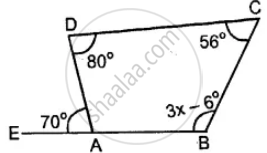
Use the information given in the following figure to find the value of x.
Advertisements
Solution
Take A, B, C, D as the vertices of Quadrilateral and BA is produced to E (say).
Since ∠EAD = 70°
∴ ∠DAB = 180° – 70°= 110° [EAB is a straight line and AD stands on it ∠EAD+ ∠DAB = 180°]
∴ 110° + 80° + 56° + 3x – 6° = 360°
[∵ sum of interior angles of a quadrilateral = 360°]
∴ 3x = 360° – 110° – 80° – 56° + 6°
3x = 360° – 240° = 120°
∴ x = 40°
RELATED QUESTIONS
ABCD is a parallelogram, AD is produced to E so that DE = DC and EC produced meets AB produced in F. Prove that BF = BC.
In a quadrilateral, define of the following Vertices .
Complete of the following, so as to make a true statement:
The number of pairs of adjacent angles of a quadrilateral is .......
Complete of the following, so as to make a true statement:
The number of pairs of opposite angles of a quadrilateral is .......
Complete of the following, so as to make a true statement:
The measure of each angle of a convex quadrilateral is ..... 180°.
PQRSTU is a regular hexagon. Determine each angle of ΔPQT.
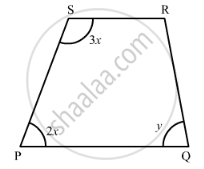
In the given figure, PQRS is an isosceles trapezium. Find x and y.
Complete the following statement by means of one of those given in brackets against each:
A line drawn from the mid-point of one side of a triangle .............. another side intersects the third side at its mid-point.
From the following figure find;
- x
- ∠ABC
- ∠ACD
One diagonal of a rectangle is 18 cm. What is the length of its other diagonal?
Observe the figure below and find out their name.

The angles of a pentagon are x°, (x - 10)°, (x + 20)°, (2x - 44)° and (2x - 70)°. Find the angles.
A quadrilateral can be drawn when all the four angles and one side is given.
In the following figure, if point A is shifted to point B along the ray PX such that PB = 2PA, then the measure of ∠BPY is ______.

The number of obtuse angles in the following figure is ______.

In the following figure, What is BD – BE?

In the following figure, What is BD – DE?

What conclusion can be drawn from part of given figure, if DB is the bisector of ∠ADC?

In quadrilateral PQRS, which pair represents adjacent sides?
