Advertisements
Advertisements
Question
In quadrilateral PQRS, ∠P : ∠Q : ∠R : ∠S = 3 : 4 : 6 : 7.
Calculate each angle of the quadrilateral and then prove that PQ and SR are parallel to each other
(i) Is PS also parallel to QR?
(ii) Assign a special name to quadrilateral PQRS.
Advertisements
Solution
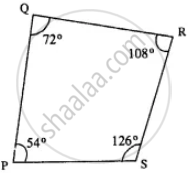
∵ ∠P : ∠Q : ∠R : ∠S = 3: 4: 6: 7
Let ∠P = 3x
∠Q = 4x
∠R = 6x
∠S = 7x
∴ ∠P + ∠Q + ∠R + ∠S = 360°
3x + 4x + 6x + 7x = 360°
20x = 360°
x = 18°
∴ ∠P = 3x = 3 × 18 = 54°
∠Q = 4x = 4 × 18 = 72°
∠R = 6x = 6 × 18 = 108°
∠S = 7x = 7 × 18 = 126°
∠Q + ∠R = 72° + 108° = 180°
or ∠P + ∠S = 54° + 126° = 180°
Hence PQ || SR
As ∠P + ∠Q = 72° + 54° = 126°
Which is ≠ 180°
∴ PS and QR are not parallel.
PQRS is a Trapezium as its one pair of opposite side is parallel.
RELATED QUESTIONS
In a quadrilateral, define of the following Vertices .
In a quadrilateral, define of the following Opposite angles .
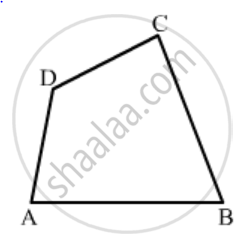
In Fig. 16.19, ABCD is a quadrilateral.
Name a pair of opposite angles.
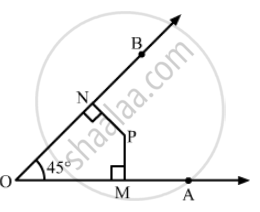
In Fig. 16.20, find the measure of ∠MPN.
In a quadrilateral ABCD, the angles A, B, C and D are in the ratio 1 : 2 : 4 : 5. Find the measure of each angle of the quadrilateral.
If ABCD is a rectangle with ∠BAC = 32°, find the measure of ∠DBC.
Two angles of a quadrilateral are 68° and 76°. If the other two angles are in the ratio 5 : 7; find the measure of each of them.
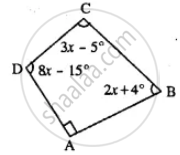
Use the information given in the following figure to find :
(i) x
(ii) ∠B and ∠C
In a quadrilateral ABCD, AO and BO are bisectors of angle A and angle B respectively. Show that:
∠AOB = (∠C + ∠D)
In parallelogram ABCD, ∠A = 90°
(i) What is the measure of angle B.
(ii) Write the special name of the parallelogram.
If three angles of a quadrilateral are 90° each, show that the given quadrilateral is a rectangle.
The three angles of a quadrilateral are 71°, 110°, 95°. Find its fourth angle.
If APB and CQD are two parallel lines, then the bisectors of the angles APQ, BPQ, CQP and PQD form ______.
In the following figure, ∠XYZ cannot be written as ______.

Number of angles less than 180° in the following figure is ______ and their names are ______.

Draw a rough sketch of a quadrilateral PQRS. Draw its diagonals. Name them. Is the meeting point of the diagonals in the interior or exterior of the quadrilateral?

Draw a rough sketch of a quadrilateral KLMN. State two pairs of adjacent sides.
Investigate :
Use strips and fasteners to make a triangle and a quadrilateral.
Try to push inward at any one vertex of the triangle. Do the same to the quadrilateral. Is the triangle distorted? Is the quadrilateral distorted? Is the triangle rigid?
Why is it that structures like electric towers make use of triangular shapes and not quadrilaterals?
How many diagonals does a quadrilateral have?
