Advertisements
Advertisements
प्रश्न
In quadrilateral PQRS, ∠P : ∠Q : ∠R : ∠S = 3 : 4 : 6 : 7.
Calculate each angle of the quadrilateral and then prove that PQ and SR are parallel to each other
(i) Is PS also parallel to QR?
(ii) Assign a special name to quadrilateral PQRS.
Advertisements
उत्तर
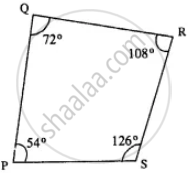
∵ ∠P : ∠Q : ∠R : ∠S = 3: 4: 6: 7
Let ∠P = 3x
∠Q = 4x
∠R = 6x
∠S = 7x
∴ ∠P + ∠Q + ∠R + ∠S = 360°
3x + 4x + 6x + 7x = 360°
20x = 360°
x = 18°
∴ ∠P = 3x = 3 × 18 = 54°
∠Q = 4x = 4 × 18 = 72°
∠R = 6x = 6 × 18 = 108°
∠S = 7x = 7 × 18 = 126°
∠Q + ∠R = 72° + 108° = 180°
or ∠P + ∠S = 54° + 126° = 180°
Hence PQ || SR
As ∠P + ∠Q = 72° + 54° = 126°
Which is ≠ 180°
∴ PS and QR are not parallel.
PQRS is a Trapezium as its one pair of opposite side is parallel.
संबंधित प्रश्न
In a quadrilateral, define of the following Sides.
In a quadrilateral, define of the following Opposite angles .
Complete of the following, so as to make a true statement:
The sum of the angles of a quiadrilateral is .... right angles.
The consecutive sides of a quadrilateral have
Use the information given in the following figure to find :
(i) x
(ii) ∠B and ∠C
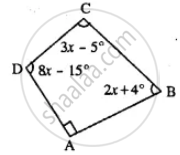
From the following figure find;
- x
- ∠ABC
- ∠ACD
Use the information given in the following figure to find the value of x.
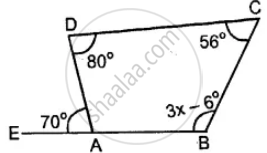
In a trapezium ABCD, side AB is parallel to side DC. If ∠A = 78° and ∠C = 120. find angles B and D.
One angle of a hexagon is 140° and the remaining angles are in the ratio 4 : 3 : 4 : 5 : 4. Calculate the measures of the smallest and the largest angles.
One angle of a pentagon is 160° and the rest are all equal angles. Find the measure of the equal angles.
Which of the following is not true for a parallelogram?
A quadrilateral can be drawn when all the four angles and one side is given.
In the following figure, if point A is shifted to point B along the ray PX such that PB = 2PA, then the measure of ∠BPY is ______.

If the sum of two angles is greater than 180°, then which of the following is not possible for the two angles?
The number of common points in the two angles marked in the following figure is ______.

In the following figure, name any two angles that appear to be obtuse angles.

Using the information given, name the right angles in part of figure:
RT ⊥ ST

Can we have two obtuse angles whose sum is a reflex angle? Why or why not?
Investigate :
Use strips and fasteners to make a triangle and a quadrilateral.
Try to push inward at any one vertex of the triangle. Do the same to the quadrilateral. Is the triangle distorted? Is the quadrilateral distorted? Is the triangle rigid?
Why is it that structures like electric towers make use of triangular shapes and not quadrilaterals?
How many points are required to form a quadrilateral?
