Advertisements
Advertisements
प्रश्न
In a trapezium ABCD, side AB is parallel to side DC. If ∠A = 78° and ∠C = 120. find angles B and D.
Advertisements
उत्तर
∵ AB || DC and BC is transversal
∴∠B and ∠C, ∠A and ∠D are Cointerior angles with their sum = 180°
i.e. ∠B + ∠C = 180°
⇒ ∠B + 120° = 180°
⇒ ∠B = 180° – 120°
⇒ ∠B = 60°
Also ∠A + ∠D = 180°
⇒ 78° + ∠D = 180°
⇒ ∠D = 180° – 78°
∠D = 102°
APPEARS IN
संबंधित प्रश्न
Complete of the following, so as to make a true statement:
In a quadrilateral the point of intersection of the diagonals lies in .... of the quadrilateral.
In Fig. 16.19, ABCD is a quadrilateral.
How many pairs of adjacent sides are there?
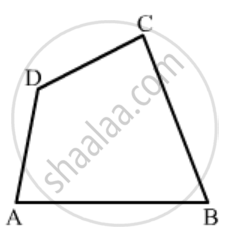
In Fig. 16.19, ABCD is a quadrilateral.
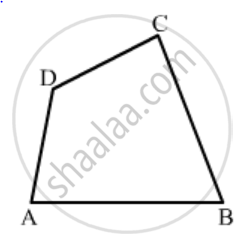
Name a pair of opposite angles.
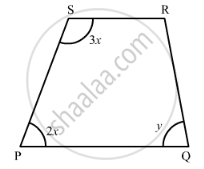
In the given figure, PQRS is an isosceles trapezium. Find x and y.
Complete the following statement by means of one of those given in brackets against each:
If one pair of opposite sides are equal and parallel, then the figure is ........................
Calculate the measure of each angle of a nonagon.
The angles of a quadrilateral are in the ratio 2 : 4 : 5 : 7. Find all the angles
In quadrilateral HOPE, the pairs of opposite sides are ______.
In quadrilateral WXYZ, the pairs of opposite angles are ______.
In the following figure, What is AE + EC?

