Advertisements
Advertisements
प्रश्न
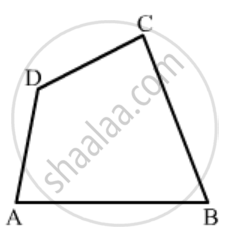
In Fig. 16.19, ABCD is a quadrilateral.
How many pairs of adjacent sides are there?
Advertisements
उत्तर
\[ \text{ Four } \]
संबंधित प्रश्न
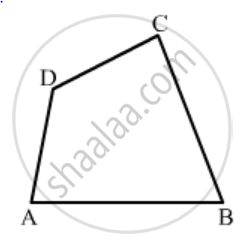
In Fig. 16.19, ABCD is a quadrilateral.
How many pairs of opposite angles are there?
Complete the following statement by means of one of those given in brackets against each:
If both pairs of opposite sides of a quadrilateral are equal, then it is necessarily a ...............
From the following figure find;
- x
- ∠ABC
- ∠ACD
Given : In quadrilateral ABCD ; ∠C = 64°, ∠D = ∠C – 8° ; ∠A = 5(a+2)° and ∠B = 2(2a+7)°.
Calculate ∠A.
ABCDE is a regular pentagon. The bisector of angle A of the pentagon meets the side CD in point M. Show that ∠AMC = 90°.
In a pentagon ABCDE, AB || ED and ∠B = 140°, ∠C = 2x° and ∠D = 3x°. Find ∠C and ∠D
A diagonal of a rectangle is inclined to one side of the rectangle at 25º. The acute angle between the diagonals is ______.
The number of common points in the two angles marked in the following figure is ______.

What conclusion can be drawn from part of given figure, if DB is the bisector of ∠ADC?

What conclusion can be drawn from part of given figure, if DC is the bisector of ∠ADB, CA ⊥ DA and CB ⊥ DB?

