Advertisements
Advertisements
प्रश्न
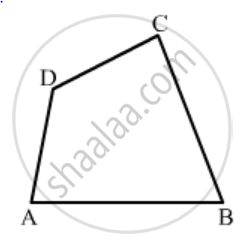
In Fig. 16.19, ABCD is a quadrilateral.
How many pairs of opposite angles are there?
Advertisements
उत्तर
Two
संबंधित प्रश्न
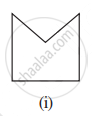
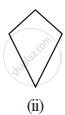
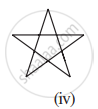
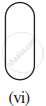
Given here are some figures:
 |
 |
 |
 |
 |
 |
 |
 |
Classify each of them on the basis of the following:
- Simple curve
- Simple closed curve
- Polygon
- Convex polygon
- Concave polygon
Complete the following statement by means of one of those given in brackets against each:
f consecutive sides of a parallelogram are equal, then it is necessarily a ..................
Given : In quadrilateral ABCD ; ∠C = 64°, ∠D = ∠C – 8° ; ∠A = 5(a+2)° and ∠B = 2(2a+7)°.
Calculate ∠A.
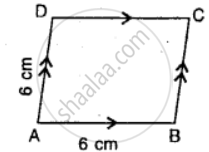
Write, giving reason, the name of the figure drawn alongside. Under what condition will this figure be a square.
The angles of a hexagon are (2x + 5)°, (3x - 5)°, (x + 40)°, (2x + 20)°, (2x + 25)° and (2x + 35)°. Find the value of x.
Three angles of a quadrilateral are 75º, 90º and 75º. The fourth angle is ______.
A quadrilateral can be drawn when all the four angles and one side is given.
The number of obtuse angles in the following figure is ______.

Draw a rough sketch of a quadrilateral KLMN. State two pairs of opposite angles.
How many points are required to form a quadrilateral?
