Advertisements
Advertisements
प्रश्न
Given here are some figures:
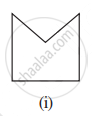 |
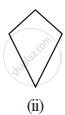 |
 |
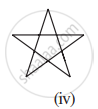 |
 |
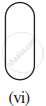 |
 |
 |
Classify each of them on the basis of the following:
- Simple curve
- Simple closed curve
- Polygon
- Convex polygon
- Concave polygon
Advertisements
उत्तर
- Simple curve: It is a curve that does not intersect itself. (i), (ii), (v), (vi) and (vii) are simple curve.
- Simple closed curve: A closed curve if it does not pass through one point more than once (i), (ii), (v), (vi) and (vii) are simple closed curve.
- Polygon: A simple closed curve made up of only line segments is called a polygon. (i) and (ii) are polygons.
- Convex polygon: A polygon that has all its interior angles less than 180°. (ii) is a convex polygon.
- Concave polygon: A polygon that has at least one interior angle greater than 180°. (i) is a concave polygon.
संबंधित प्रश्न
What is the sum of the measures of the angels of a convex quadrilateral? Will this property hold if the quadrilateral is not convex? (Make a non-convex quadrilateral and try!)
In a quadrilateral, define of the following Angles .
In a quadrilateral, define of the following Adjacent angles .
Complete of the following, so as to make a true statement:
A quadrilateral is convex if, for each side, the remaining ______ lie on the same side of the line containing the side.
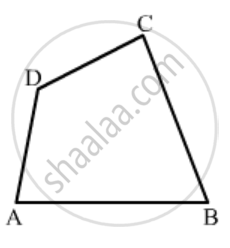
In Fig. 16.19, ABCD is a quadrilateral.
Name a pair of adjacent sides.
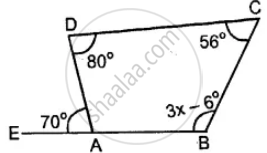
Use the information given in the following figure to find the value of x.
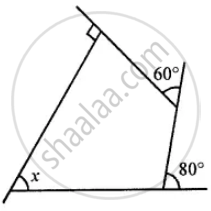
Use the following figure to find the value of x
The angles A, B, C and D of a trapezium ABCD are in the ratio 3: 4: 5: 6. Le. ∠A : ∠B : ∠C : ∠D = 3:4: 5 : 6. Find all the angles of the trapezium. Also, name the two sides of this trapezium which are parallel to each other. Give reason for your answer.
If angles A, B, C and D of the quadrilateral ABCD, taken in order, are in the ratio 3 : 7 : 6 : 4, then ABCD is a ______.
Draw a rough sketch of a quadrilateral KLMN. State two pairs of opposite sides.
