Advertisements
Advertisements
प्रश्न
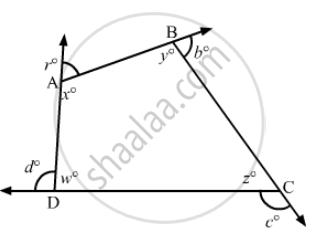
The sides of a quadrilateral are produced in order. What is the sum of the four exterior angles?
Advertisements
उत्तर
\[\text{ The sides of the quadrilateral ABCD are produced in order (according to figure) . } \]
\[\text{ Now, we need to find the sum of the exterior angles } . \]
\[\text{ Since the angles made on the same side of straight line are } 180 °, \text{ i . e . , linear pair, we have: } \]
\[a + x + b + y + c + z + w + d = 180° + 180° + 180° + 180°= 720° \]
\[OR \]
\[\text{ Sum of the interior angles + sum of exterior the angles } = 180 ° \times 4 = 720° \]
\[ \text{ Since the sum of the interior angles of a quadrilateral is } 360° , \text{ we have } : \]
\[w + x + y + z = 360° \]
\[ \text{ Substituing the value, we get } : \]
\[a + b + c + d = 360° \]
\[ \therefore \text{ Sum of the exterior angles } = 360 ° \]
संबंधित प्रश्न
Define the following term Quadrilateral .
In a quadrilateral ABCD, the angles A, B, C and D are in the ratio 1 : 2 : 4 : 5. Find the measure of each angle of the quadrilateral.
In a quadrilateral ABCD, CO and DO are the bisectors of ∠C and ∠D respectively. Prove that \[∠COD = \frac{1}{2}(∠A + ∠B) .\]
Complete the following statement by means of one of those given in brackets against each:
A line drawn from the mid-point of one side of a triangle .............. another side intersects the third side at its mid-point.
One diagonal of a rectangle is 18 cm. What is the length of its other diagonal?
In a quadrilateral ABCD, ∠A = 72° and ∠C is the supplementary of ∠A. The other two angles are 2x – 10 and x + 4. Find the value of x and the measure of all the angles
ABCD is a quadrilateral in which AB || DC and AD = BC. Prove that ∠A = ∠B and ∠C = ∠D.
The number of common points in the two angles marked in the following figure is ______.

Draw a rough sketch of a quadrilateral KLMN. State two pairs of opposite sides.
Draw a rough sketch of a quadrilateral KLMN. State two pairs of opposite angles.
