Advertisements
Advertisements
Question
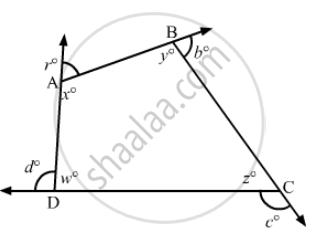
The sides of a quadrilateral are produced in order. What is the sum of the four exterior angles?
Advertisements
Solution
\[\text{ The sides of the quadrilateral ABCD are produced in order (according to figure) . } \]
\[\text{ Now, we need to find the sum of the exterior angles } . \]
\[\text{ Since the angles made on the same side of straight line are } 180 °, \text{ i . e . , linear pair, we have: } \]
\[a + x + b + y + c + z + w + d = 180° + 180° + 180° + 180°= 720° \]
\[OR \]
\[\text{ Sum of the interior angles + sum of exterior the angles } = 180 ° \times 4 = 720° \]
\[ \text{ Since the sum of the interior angles of a quadrilateral is } 360° , \text{ we have } : \]
\[w + x + y + z = 360° \]
\[ \text{ Substituing the value, we get } : \]
\[a + b + c + d = 360° \]
\[ \therefore \text{ Sum of the exterior angles } = 360 ° \]
RELATED QUESTIONS
Define the following term Convex Quadrilateral .
Complete of the following, so as to make a true statement:
The sum of the angles of a quiadrilateral is .... right angles.
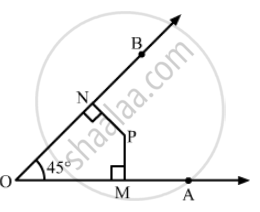
In Fig. 16.20, find the measure of ∠MPN.
In a convex hexagon, prove that the sum of all interior angle is equal to twice the sum of its exterior angles formed by producing the sides in the same order.
Complete the following statement by means of one of those given in brackets against each:
f consecutive sides of a parallelogram are equal, then it is necessarily a ..................
Angle A of an isosceles trapezium ABCD is 115°; find the angles B, C and D.
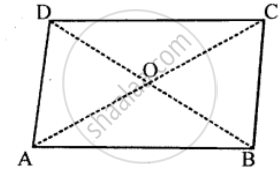
In parallelogram ABCD, its diagonals intersect at point O. If OA = 6 cm and OB = 7.5 cm, find the length of AC and BD.
One diagonal of a rectangle is 18 cm. What is the length of its other diagonal?
Measures of the two angles between hour and minute hands of a clock at 9 O’ clock are ______.
Using the information given, name the right angles in part of figure:
AC ⊥ CD

