Advertisements
Advertisements
Question
In a quadrilateral ABCD, CO and DO are the bisectors of ∠C and ∠D respectively. Prove that \[∠COD = \frac{1}{2}(∠A + ∠B) .\]
Advertisements
Solution

\[ ∠COD = 180° - \left(∠OCD + ∠ODC \right)\]
\[ = 180°- \frac{1}{2}\left(∠C + ∠D \right)\]
\[ = 180°- \frac{1}{2}\left[ 360° - \left(∠A + ∠B \right) \right]\]
\[ = 180°- 180°+ \frac{1}{2}\left( ∠A + ∠B \right)\]
\[ = \frac{1}{2}\left( ∠A +∠B \right)\]
\[ = RHS\]
\[\text{ Hence proved } .\]
RELATED QUESTIONS
In a quadrilateral, define of the following Angles .
The three angles of a quadrilateral are respectively equal to 110°, 50° and 40°. Find its fourth angle.
The sum of the interior angles of a polygon is three times the sum of its exterior angles. Determine the number of sided of the polygon.
If ABCD is a rectangle with ∠BAC = 32°, find the measure of ∠DBC.
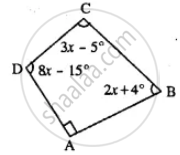
Use the information given in the following figure to find :
(i) x
(ii) ∠B and ∠C
If APB and CQD are two parallel lines, then the bisectors of the angles APQ, BPQ, CQP and PQD form ______.
The diagonals of the quadrilateral DEFG are ______ and ______.
Measures of the two angles between hour and minute hands of a clock at 9 O’ clock are ______.
In the following figure, if point A is shifted to point B along the ray PX such that PB = 2PA, then the measure of ∠BPY is ______.

Which of the following represents the vertices of quadrilateral ABCD?
