Advertisements
Advertisements
प्रश्न
In a quadrilateral ABCD, CO and DO are the bisectors of ∠C and ∠D respectively. Prove that \[∠COD = \frac{1}{2}(∠A + ∠B) .\]
Advertisements
उत्तर

\[ ∠COD = 180° - \left(∠OCD + ∠ODC \right)\]
\[ = 180°- \frac{1}{2}\left(∠C + ∠D \right)\]
\[ = 180°- \frac{1}{2}\left[ 360° - \left(∠A + ∠B \right) \right]\]
\[ = 180°- 180°+ \frac{1}{2}\left( ∠A + ∠B \right)\]
\[ = \frac{1}{2}\left( ∠A +∠B \right)\]
\[ = RHS\]
\[\text{ Hence proved } .\]
संबंधित प्रश्न
Complete of the following, so as to make a true statement:
A quadrilateral has .... diagonals.
Complete of the following, so as to make a true statement:
A diagonal of a quadrilateral is a line segment that joins two ...... vertices of the quadrilateral.
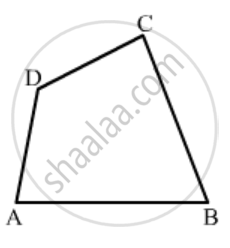
In Fig. 16.19, ABCD is a quadrilateral.
How many pairs of opposite sides are there?
The three angles of a quadrilateral are respectively equal to 110°, 50° and 40°. Find its fourth angle.
A quadrilateral has three acute angles each measures 80°. What is the measure of the fourth angle?
The sum of the interior angles of a polygon is three times the sum of its exterior angles. Determine the number of sided of the polygon.
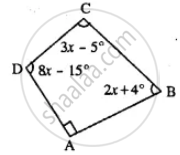
Use the information given in the following figure to find :
(i) x
(ii) ∠B and ∠C
The angles A, B, C and D of a trapezium ABCD are in the ratio 3: 4: 5: 6. Le. ∠A : ∠B : ∠C : ∠D = 3:4: 5 : 6. Find all the angles of the trapezium. Also, name the two sides of this trapezium which are parallel to each other. Give reason for your answer.
In a pentagon ABCDE, AB || ED and ∠B = 140°, ∠C = 2x° and ∠D = 3x°. Find ∠C and ∠D
Construct a quadrilateral NEWS in which NE = 7 cm, EW = 6 cm, ∠N = 60°, ∠E = 110° and ∠S = 85°.
