Advertisements
Advertisements
प्रश्न
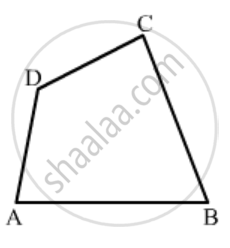
In a quadrilateral ABCD, CO and DO are the bisectors of ∠C and ∠D respectively. Prove that \[∠COD = \frac{1}{2}(∠A + ∠B) .\]
Advertisements
उत्तर

\[ ∠COD = 180° - \left(∠OCD + ∠ODC \right)\]
\[ = 180°- \frac{1}{2}\left(∠C + ∠D \right)\]
\[ = 180°- \frac{1}{2}\left[ 360° - \left(∠A + ∠B \right) \right]\]
\[ = 180°- 180°+ \frac{1}{2}\left( ∠A + ∠B \right)\]
\[ = \frac{1}{2}\left( ∠A +∠B \right)\]
\[ = RHS\]
\[\text{ Hence proved } .\]
संबंधित प्रश्न
In Fig. 16.19, ABCD is a quadrilateral.
Name a pair of adjacent sides.
The measure of angles of a hexagon are x°, (x − 5)°, (x − 5)°, (2x − 5)°, (2x − 5)°, (2x + 20)°. Find the value of x.
Complete the following statement by means of one of those given in brackets against each:
If both pairs of opposite sides of a quadrilateral are equal, then it is necessarily a ...............
If ABCD is a rectangle with ∠BAC = 32°, find the measure of ∠DBC.
Two diagonals of an isosceles trapezium are x cm and (3x – 8) cm. Find the value of x.
In parallelogram ABCD, its diagonals intersect at point O. If OA = 6 cm and OB = 7.5 cm, find the length of AC and BD.
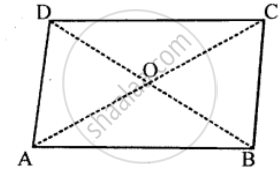
ABCD is a rhombus such that ∠ACB = 40º. Then ∠ADB is ______.
A quadrilateral can be drawn when all the four angles and one side is given.
The common part between the two angles BAC and DAB in the following figure is ______.

Using the information given, name the right angles in part of figure:
AC ⊥ BD

