Advertisements
Advertisements
प्रश्न
Two angles of a quadrilateral are of measure 65° and the other two angles are equal. What is the measure of each of these two angles?
Advertisements
उत्तर
\[ \text{ Let x be the measure of each angle } . \]
\[\text{ Since, the sum of all the angles of a quadrilateral is } 360 °, \text{ we have: } \]
\[65° + 65° + x° + x° = 360° \]
\[ \Rightarrow 2x° + 130°= 360° \]
\[ \Rightarrow 2x° = 230° \]
\[ \Rightarrow x° = 115°\]
\[ \therefore \text{ The measure of each angle is } 115° .\]
संबंधित प्रश्न
What is the sum of the measures of the angels of a convex quadrilateral? Will this property hold if the quadrilateral is not convex? (Make a non-convex quadrilateral and try!)
Complete of the following, so as to make a true statement:
A quadrilateral has ...... angles.
Complete of the following, so as to make a true statement:
In a quadrilateral the point of intersection of the diagonals lies in .... of the quadrilateral.
Complete of the following, so as to make a true statement:
A point is in the interior of a convex quadrilateral, if it is in the ..... of its two opposite angles.
The angles of a quadrilateral are 110°, 72°, 55° and x°. Find the value of x.
Complete the following statement by means of one of those given in brackets against each:
If one pair of opposite sides are equal and parallel, then the figure is ........................
ABCD is a trapezium in which AB || DC. M and N are the mid-points of AD and the respectively. If AB = 12 cm, MN = 14 cm, then CD =
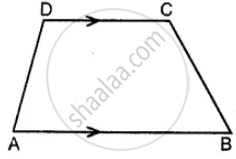
The following figure shows a quadrilateral in which sides AB and DC are parallel. If ∠A : ∠D = 4 : 5, ∠B = (3x – 15)° and ∠C = (4x + 20)°, find each angle of the quadrilateral ABCD.
The angles A, B, C and D of a quadrilateral are in the ratio 2 : 3 : 2 : 3. Show this quadrilateral is a parallelogram.
Both the pairs of opposite angles of a quadrilateral are equal and supplementary. Find the measure of each angle.
