Advertisements
Advertisements
प्रश्न
Angle A of an isosceles trapezium ABCD is 115°; find the angles B, C and D.
Advertisements
उत्तर
Since the base angles of an isosceles trapezium are equal,
∴ ∠A = ∠B = 115°

Also, ∠A and ∠D are co-interior angles and their sum = 180°
∴ ∠A + ∠D = 180°
⇒115° + ∠D = 180°
⇒ ∠D = 180° - 115°
⇒ ∠D = 65°
Also, ∠D = ∠C = 65°
∴ ∠B = 115°, ∠C = 65°, ∠D = 65°
APPEARS IN
संबंधित प्रश्न
Complete of the following, so as to make a true statement:
A quadrilateral has ...... angles.
Complete of the following, so as to make a true statement:
The sum of the angles of a quiadrilateral is .... right angles.
Complete of the following, so as to make a true statement:
A quadrilateral is convex if, for each side, the remaining ______ lie on the same side of the line containing the side.
In Fig. 16.19, ABCD is a quadrilateral.
Name a pair of adjacent sides.
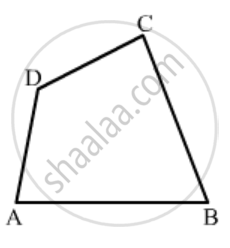
The sum of the interior angles of a polygon is three times the sum of its exterior angles. Determine the number of sided of the polygon.
Complete the following statement by means of one of those given in brackets against each:
If opposite angles of a quadrilateral are equal, then it is necessarily a ....................
If ABCD is a rectangle with ∠BAC = 32°, find the measure of ∠DBC.
Use the information given in the following figure to find :
(i) x
(ii) ∠B and ∠C
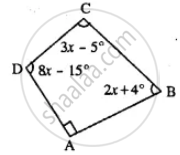
In quadrilateral ABCD, side AB is parallel to side DC. If ∠A : ∠D = 1 : 2 and ∠C : ∠B = 4 : 5
(i) Calculate each angle of the quadrilateral.
(ii) Assign a special name to quadrilateral ABCD
A diagonal of a rectangle is inclined to one side of the rectangle at 25º. The acute angle between the diagonals is ______.
