Advertisements
Advertisements
प्रश्न
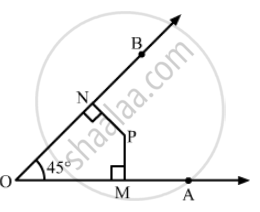
In Fig. 16.20, find the measure of ∠MPN.
Advertisements
उत्तर
\[\text{ Since the sum of all the angles of a quadrilateral is } 360°, \text{ we have } : \]
\[45° + 90° + 90° + ∠MPN = 360° \]
\[ \Rightarrow 225° + ∠MPN = 360°\]
\[ \therefore ∠MPN = 135° \]
संबंधित प्रश्न
How many diagonals does following have?
A triangle
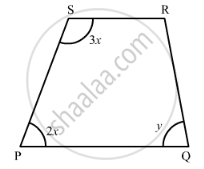
In the given figure, PQRS is an isosceles trapezium. Find x and y.
Complete the following statement by means of one of those given in brackets against each:
If opposite angles of a quadrilateral are equal, then it is necessarily a ....................
In a trapezium ABCD, side AB is parallel to side DC. If ∠A = 78° and ∠C = 120. find angles B and D.
In an isosceles trapezium one pair of opposite sides are _____ to each Other and the other pair of opposite sides are _____ to each other.
The angles of a pentagon are x°, (x - 10)°, (x + 20)°, (2x - 44)° and (2x - 70)°. Find the angles.
ΔPQR and ΔSQR are on the same base QR with P and S on opposite sides of line QR, such that area of ΔPQR is equal to the area of ΔSQR. Show that QR bisects PS.
ABCD is a quadrilateral in which AB || DC and AD = BC. Prove that ∠A = ∠B and ∠C = ∠D.
In quadrilateral HOPE, the pairs of opposite sides are ______.
In the following figure, name any four angles that appear to be acute angles.

