Advertisements
Advertisements
प्रश्न
Given here are some figures:
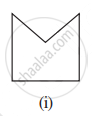 |
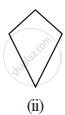 |
 |
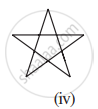 |
 |
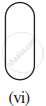 |
 |
 |
Classify each of them on the basis of the following:
- Simple curve
- Simple closed curve
- Polygon
- Convex polygon
- Concave polygon
Advertisements
उत्तर
- Simple curve: It is a curve that does not intersect itself. (i), (ii), (v), (vi) and (vii) are simple curve.
- Simple closed curve: A closed curve if it does not pass through one point more than once (i), (ii), (v), (vi) and (vii) are simple closed curve.
- Polygon: A simple closed curve made up of only line segments is called a polygon. (i) and (ii) are polygons.
- Convex polygon: A polygon that has all its interior angles less than 180°. (ii) is a convex polygon.
- Concave polygon: A polygon that has at least one interior angle greater than 180°. (i) is a concave polygon.
संबंधित प्रश्न
In a quadrilateral, define of the following Sides.
In a quadrilateral, define of the following Vertices .
In Fig. 16.19, ABCD is a quadrilateral.
How many pairs of adjacent sides are there?
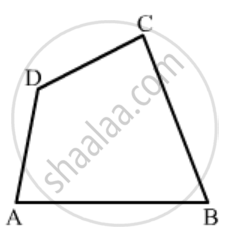
In Fig. 16.19, ABCD is a quadrilateral.
Name a pair of adjacent angles.
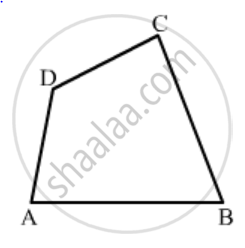
Three angles of a quadrilateral are equal. Fourth angle is of measure 150°. What is the measure of equal angles.
The four angles of a quadrilateral are as 3 : 5 : 7 : 9. Find the angles.
Mark the correct alternative in each of the following:
The opposite sides of a quadrilateral have
In a pentagon ABCDE, AB || ED and ∠B = 140°, ∠C = 2x° and ∠D = 3x°. Find ∠C and ∠D
In the following figure, name any two angles that appear to be obtuse angles.

In the following figure, What is BD – DE?

