Advertisements
Advertisements
Question
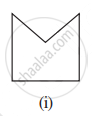
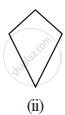
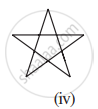
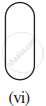
Given here are some figures:
 |
 |
 |
 |
 |
 |
 |
 |
Classify each of them on the basis of the following:
- Simple curve
- Simple closed curve
- Polygon
- Convex polygon
- Concave polygon
Advertisements
Solution
- Simple curve: It is a curve that does not intersect itself. (i), (ii), (v), (vi) and (vii) are simple curve.
- Simple closed curve: A closed curve if it does not pass through one point more than once (i), (ii), (v), (vi) and (vii) are simple closed curve.
- Polygon: A simple closed curve made up of only line segments is called a polygon. (i) and (ii) are polygons.
- Convex polygon: A polygon that has all its interior angles less than 180°. (ii) is a convex polygon.
- Concave polygon: A polygon that has at least one interior angle greater than 180°. (i) is a concave polygon.
RELATED QUESTIONS
In a quadrilateral, define of the following Angles .
In a quadrilateral, define of the following Diagonals .
The four angles of a quadrilateral are as 3 : 5 : 7 : 9. Find the angles.
Complete the following statement by means of one of those given in brackets against each:
A line drawn from the mid-point of one side of a triangle .............. another side intersects the third side at its mid-point.
Which of the following quadrilateral is not a rhombus?
Three angles of a quadrilateral are equal. If the fourth angle is 69°; find the measure of equal angles.
The number of straight angles in the following figure is ______.

In the following figure, What is AC – EC?

What conclusion can be drawn from part of given figure, if DC is the bisector of ∠ADB, CA ⊥ DA and CB ⊥ DB?

An angle is said to be trisected, if it is divided into three equal parts. If in the following figure, ∠BAC = ∠CAD = ∠DAE, how many trisectors are there for ∠BAE?

