Advertisements
Advertisements
प्रश्न
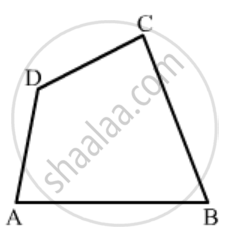
In Fig. 16.19, ABCD is a quadrilateral.
How many pairs of adjacent sides are there?
Advertisements
उत्तर
\[ \text{ Four } \]
संबंधित प्रश्न
In a quadrilateral, define of the following Adjacent sides .
Complete the following statement by means of one of those given in brackets against each:
If opposite angles of a quadrilateral are equal, then it is necessarily a ....................
The consecutive sides of a quadrilateral have
Two adjacent angles of a parallelogram are 70° and 110° respectively. Find the other two angles of it.
The angles A, B, C and D of a quadrilateral are in the ratio 2 : 3 : 2 : 3. Show this quadrilateral is a parallelogram.
Find the angles of a pentagon which are in the ratio 4: 4: 6: 7: 6.
The angles of a quadrilateral are in the ratio 2 : 4 : 5 : 7. Find all the angles
In quadrilateral ROPE, the pairs of adjacent angles are ______.
Using the information given, name the right angles in part of figure:
AC ⊥ CD

Draw a rough sketch of a quadrilateral KLMN. State two pairs of adjacent sides.
