Advertisements
Advertisements
Question
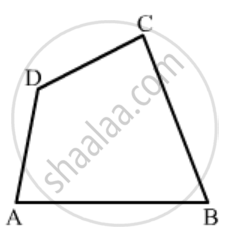
In Fig. 16.19, ABCD is a quadrilateral.
How many pairs of adjacent sides are there?
Advertisements
Solution
\[ \text{ Four } \]
RELATED QUESTIONS
How many diagonals does following have?
A convex quadrilateral
How many diagonals does following have?
A regular hexagon
In a quadrilateral, define of the following Opposite sides .
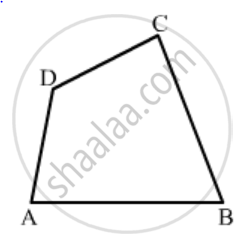
In Fig. 16.19, ABCD is a quadrilateral.
Name a pair of opposite angles.
In ΔABC, E is the mid-point of median AD such that BE produced meets AC at F. IF AC = 10.5 cm, then AF =
In an isosceles trapezium one pair of opposite sides are _____ to each Other and the other pair of opposite sides are _____ to each other.
Two diagonals of an isosceles trapezium are x cm and (3x – 8) cm. Find the value of x.
If bisectors of ∠A and ∠B of a quadrilateral ABCD intersect each other at P, of ∠B and ∠C at Q, of ∠C and ∠D at R and of ∠D and ∠A at S, then PQRS is a ______.
In the following figure, ∠XYZ cannot be written as ______.

An angle is said to be trisected, if it is divided into three equal parts. If in the following figure, ∠BAC = ∠CAD = ∠DAE, how many trisectors are there for ∠BAE?

