Advertisements
Advertisements
Question
In a trapezium ABCD, side AB is parallel to side DC. If ∠A = x° and ∠D = (3x – 20)°; find the value of x.
Advertisements
Solution
∵ AB || DC and BC is transversal
∴ ∠A and ∠B are Co-interior angles with their sum = 180°
i.e. ∠A + ∠D = 180°
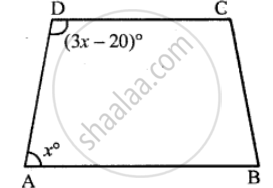
⇒ x° + (3x – 20)° = 180°
⇒ x° + 3x° – 20° = 180°
⇒ 4x° = 180° + 20°
x° = `200/4` = 50°
∴ Value of x = 50°
APPEARS IN
RELATED QUESTIONS
Define the following term Quadrilateral .
Complete of the following, so as to make a true statement:
A point is in the interior of a convex quadrilateral, if it is in the ..... of its two opposite angles.
The angles of a quadrilateral are 110°, 72°, 55° and x°. Find the value of x.
A quadrilateral has all its four angles of the same measure. What is the measure of each?
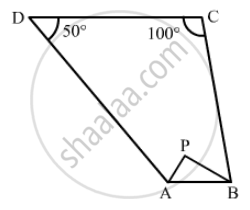
In Fig. 16.21, the bisectors of ∠A and ∠B meet at a point P. If ∠C = 100° and ∠D = 50°, find the measure of ∠APB.
In a quadrilateral ABCD, CO and DO are the bisectors of ∠C and ∠D respectively. Prove that \[∠COD = \frac{1}{2}(∠A + ∠B) .\]
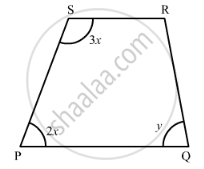
In the given figure, PQRS is an isosceles trapezium. Find x and y.
If bisectors of ∠A and ∠B of a quadrilateral ABCD intersect each other at P, of ∠B and ∠C at Q, of ∠C and ∠D at R and of ∠D and ∠A at S, then PQRS is a ______.
D and E are the mid-points of the sides AB and AC respectively of ∆ABC. DE is produced to F. To prove that CF is equal and parallel to DA, we need an additional information which is ______.
Both the pairs of opposite angles of a quadrilateral are equal and supplementary. Find the measure of each angle.
