Advertisements
Advertisements
प्रश्न
Angle A of an isosceles trapezium ABCD is 115°; find the angles B, C and D.
Advertisements
उत्तर
Since the base angles of an isosceles trapezium are equal,
∴ ∠A = ∠B = 115°

Also, ∠A and ∠D are co-interior angles and their sum = 180°
∴ ∠A + ∠D = 180°
⇒115° + ∠D = 180°
⇒ ∠D = 180° - 115°
⇒ ∠D = 65°
Also, ∠D = ∠C = 65°
∴ ∠B = 115°, ∠C = 65°, ∠D = 65°
APPEARS IN
संबंधित प्रश्न
How many diagonals does following have?
A regular hexagon
Complete of the following, so as to make a true statement:
A quadrilateral has ....... sides.
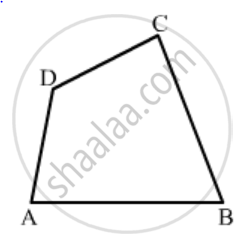
In Fig. 16.19, ABCD is a quadrilateral.
Name a pair of opposite angles.
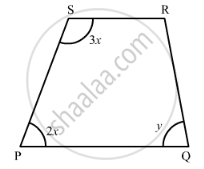
In the given figure, PQRS is an isosceles trapezium. Find x and y.
Complete the following statement by means of one of those given in brackets against each:
If in a quadrilateral only one pair of opposite sides are parallel, the quadrilateral is ................
In parallelogram ABCD, ∠A = 90°
(i) What is the measure of angle B.
(ii) Write the special name of the parallelogram.
In the quadrilateral ABCD, AB = BC and AD = DC Measure of ∠BCD is
Construct a quadrilateral NEWS in which NE = 7 cm, EW = 6 cm, ∠N = 60°, ∠E = 110° and ∠S = 85°.
The number of straight angles in the following figure is ______.

Can we have two obtuse angles whose sum is a complete angle? Why or why not?
