Advertisements
Advertisements
Question
Angle A of an isosceles trapezium ABCD is 115°; find the angles B, C and D.
Advertisements
Solution
Since the base angles of an isosceles trapezium are equal,
∴ ∠A = ∠B = 115°

Also, ∠A and ∠D are co-interior angles and their sum = 180°
∴ ∠A + ∠D = 180°
⇒115° + ∠D = 180°
⇒ ∠D = 180° - 115°
⇒ ∠D = 65°
Also, ∠D = ∠C = 65°
∴ ∠B = 115°, ∠C = 65°, ∠D = 65°
APPEARS IN
RELATED QUESTIONS
Complete of the following, so as to make a true statement:
The number of pairs of opposite angles of a quadrilateral is .......
In Fig. 16.20, find the measure of ∠MPN.
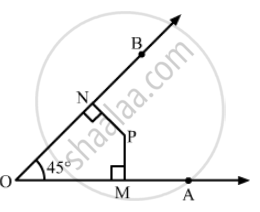
The sum of the interior angles of a polygon is three times the sum of its exterior angles. Determine the number of sided of the polygon.
Mark the correct alternative in each of the following:
The opposite sides of a quadrilateral have
In an isosceles trapezium one pair of opposite sides are _____ to each Other and the other pair of opposite sides are _____ to each other.
If three angles of a quadrilateral are 90° each, show that the given quadrilateral is a rectangle.
Calculate the measure of each angle of a nonagon.
A pair of opposite sides of a trapezium are ______.
In the following figure, What is AE + EC?

What conclusion can be drawn from part of given figure, if DB is the bisector of ∠ADC?

