Advertisements
Advertisements
Question
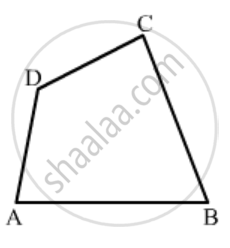
In Fig. 16.19, ABCD is a quadrilateral.
Name a pair of adjacent sides.
Advertisements
Solution
\[ \text{ (AB, BC) or (BC, CD) or (CD, DA) or (AD, AB) } \]
RELATED QUESTIONS
In a quadrilateral, define of the following Adjacent sides .
Complete of the following, so as to make a true statement:
A quadrilateral has ...... angles.
A quadrilateral has all its four angles of the same measure. What is the measure of each?
The four angles of a quadrilateral are as 3 : 5 : 7 : 9. Find the angles.
Determine the number of sides of a polygon whose exterior and interior angles are in the ratio 1 : 5.
Complete the following statement by means of one of those given in brackets against each:
If both pairs of opposite sides of a quadrilateral are equal, then it is necessarily a ...............
If the bisectors of two adjacent angles A and B of a quadrilateral ABCD intersect at a point O such that ∠C + ∠D = k ∠AOB, then find the value of k.
The consecutive sides of a quadrilateral have
Using the information given, name the right angles in part of figure:
AC ⊥ BD

Draw a rough sketch of a quadrilateral KLMN. State two pairs of adjacent angles.
