Advertisements
Advertisements
Question
Determine the number of sides of a polygon whose exterior and interior angles are in the ratio 1 : 5.
Advertisements
Solution
\[\text{ Let n be the number of sides of a polygon } . \]
\[\text { Let x and 5x be the exterior and interior angles } . \]
\[\text{ Since the sum of an interior and the corresponding exterior angle is } 180° , \text{ we have } : \]
\[x + 5x = 180° \]
\[ \Rightarrow 6x = 180° \]
\[ \Rightarrow x = 30° \]
\[\text{ The polygon has n sides } . \]
\[\text{ So, sum of all the exterior angles } = \left( 30n \right)° \]
\[\text{ We know that the sum of all the exterior angles of a polygon is } 360° . \]
\[i . e . , 30n = 360\]
\[ \therefore n = 12\]
RELATED QUESTIONS
How many diagonals does following have?
A convex quadrilateral
In a quadrilateral, define of the following Opposite sides .
Complete of the following, so as to make a true statement:
The sum of the angles of a quiadrilateral is .... right angles.
Two angles of a quadrilateral are 68° and 76°. If the other two angles are in the ratio 5 : 7; find the measure of each of them.
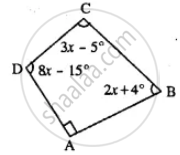
Use the information given in the following figure to find :
(i) x
(ii) ∠B and ∠C
Observe the figure below and find out their name.

Three angles of a quadrilateral are 75º, 90º and 75º. The fourth angle is ______.
A diagonal of a rectangle is inclined to one side of the rectangle at 25º. The acute angle between the diagonals is ______.
Using the information given, name the right angles in part of figure:
RS ⊥ RW

Draw a rough sketch of a quadrilateral KLMN. State two pairs of opposite angles.
