Advertisements
Advertisements
प्रश्न
Determine the number of sides of a polygon whose exterior and interior angles are in the ratio 1 : 5.
Advertisements
उत्तर
\[\text{ Let n be the number of sides of a polygon } . \]
\[\text { Let x and 5x be the exterior and interior angles } . \]
\[\text{ Since the sum of an interior and the corresponding exterior angle is } 180° , \text{ we have } : \]
\[x + 5x = 180° \]
\[ \Rightarrow 6x = 180° \]
\[ \Rightarrow x = 30° \]
\[\text{ The polygon has n sides } . \]
\[\text{ So, sum of all the exterior angles } = \left( 30n \right)° \]
\[\text{ We know that the sum of all the exterior angles of a polygon is } 360° . \]
\[i . e . , 30n = 360\]
\[ \therefore n = 12\]
संबंधित प्रश्न
In a quadrilateral, define of the following Interior .
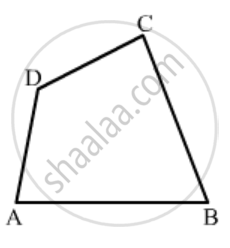
In Fig. 16.19, ABCD is a quadrilateral.
Name a pair of adjacent sides.
Complete the following statement by means of one of those given in brackets against each:
A line drawn from the mid-point of one side of a triangle .............. another side intersects the third side at its mid-point.
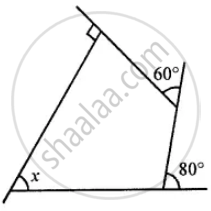
Use the following figure to find the value of x
In a trapezium ABCD, side AB is parallel to side DC. If ∠A = 78° and ∠C = 120. find angles B and D.
The angles A, B, C and D of a trapezium ABCD are in the ratio 3: 4: 5: 6. Le. ∠A : ∠B : ∠C : ∠D = 3:4: 5 : 6. Find all the angles of the trapezium. Also, name the two sides of this trapezium which are parallel to each other. Give reason for your answer.
Write two conditions that will make the adjoining figure a square.

Observe the figure below and find out their name.

Draw a rough sketch of a quadrilateral KLMN. State two pairs of opposite angles.
Which of the following is a key requirement for correctly naming a □ABCD?
