Advertisements
Advertisements
प्रश्न
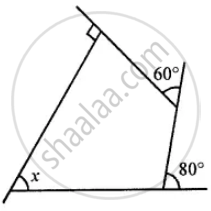
Use the following figure to find the value of x
Advertisements
उत्तर
The sum of exterior angles of a quadrilateral
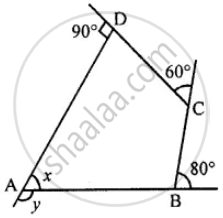
⇒ y + 80° + 60° + 90° = 360°
⇒ y + 230° = 360°
⇒ y = 360° – 230° = 130°
At vertex A,
∠y + ∠x = 180° (Linear pair)
x = 180° – 130°
⇒ x = 50°
APPEARS IN
संबंधित प्रश्न
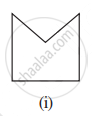
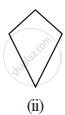
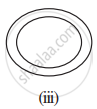
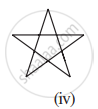
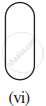
Given here are some figures:
 |
 |
 |
 |
 |
 |
 |
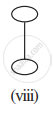 |
Classify each of them on the basis of the following:
- Simple curve
- Simple closed curve
- Polygon
- Convex polygon
- Concave polygon
In a quadrilateral, define of the following Angles .
Complete of the following, so as to make a true statement:
The number of pairs of opposite angles of a quadrilateral is .......
A quadrilateral has three acute angles each measures 80°. What is the measure of the fourth angle?
Complete the following statement by means of one of those given in brackets against each:
f consecutive sides of a parallelogram are equal, then it is necessarily a ..................
In a trapezium ABCD, side AB is parallel to side DC. If ∠A = x° and ∠D = (3x – 20)°; find the value of x.
If angles A, B, C and D of the quadrilateral ABCD, taken in order, are in the ratio 3 : 7 : 6 : 4, then ABCD is a ______.
Using the information given, name the right angles in part of figure:
AC ⊥ CD

Draw a rough sketch of a quadrilateral KLMN. State two pairs of opposite sides.
Which of the following is a key requirement for correctly naming a □ABCD?
