Advertisements
Advertisements
प्रश्न
A quadrilateral has three acute angles each measures 80°. What is the measure of the fourth angle?
Advertisements
उत्तर
\[\text{ Let x be the fourth angle } . \]
\[ \text{ Since, the sum of all angles of a quadrilateral is } 360°, \text{ we have: } \]
\[80° + 80° + 80° + x = 360° \]
\[ \Rightarrow 240° + x = 360° \]
\[ \Rightarrow x = 120° \]
\[ \therefore \text{ The fourth angle is } 120° .\]
संबंधित प्रश्न
Given here are some figures:
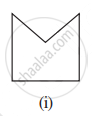 |
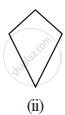 |
 |
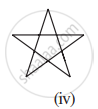 |
 |
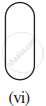 |
 |
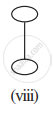 |
Classify each of them on the basis of the following:
- Simple curve
- Simple closed curve
- Polygon
- Convex polygon
- Concave polygon
Define the following term Quadrilateral .
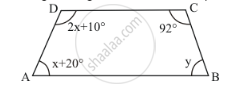
In the given figure, ABCD is a trapezium. Find the values of x and y.
Given : In quadrilateral ABCD ; ∠C = 64°, ∠D = ∠C – 8° ; ∠A = 5(a+2)° and ∠B = 2(2a+7)°.
Calculate ∠A.
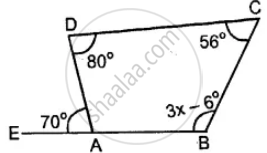
Use the information given in the following figure to find the value of x.
One diagonal of a rectangle is 18 cm. What is the length of its other diagonal?
Calculate the measure of each angle of a nonagon.
In the quadrilateral ABCD, AB = BC and AD = DC Measure of ∠BCD is
Draw a rough sketch of a quadrilateral KLMN. State two pairs of opposite angles.
How many diagonals does a quadrilateral have?
