Advertisements
Advertisements
Question
A quadrilateral has three acute angles each measures 80°. What is the measure of the fourth angle?
Advertisements
Solution
\[\text{ Let x be the fourth angle } . \]
\[ \text{ Since, the sum of all angles of a quadrilateral is } 360°, \text{ we have: } \]
\[80° + 80° + 80° + x = 360° \]
\[ \Rightarrow 240° + x = 360° \]
\[ \Rightarrow x = 120° \]
\[ \therefore \text{ The fourth angle is } 120° .\]
RELATED QUESTIONS
Complete of the following, so as to make a true statement:
A quadrilateral has ..... vertices, no three of which are .....
In a quadrilateral ABCD, the angles A, B, C and D are in the ratio 1 : 2 : 4 : 5. Find the measure of each angle of the quadrilateral.
PQRSTU is a regular hexagon. Determine each angle of ΔPQT.
In the given figure, PQRS is an isosceles trapezium. Find x and y.
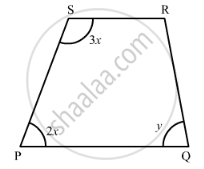
The angles A, B, C and D of a trapezium ABCD are in the ratio 3: 4: 5: 6. Le. ∠A : ∠B : ∠C : ∠D = 3:4: 5 : 6. Find all the angles of the trapezium. Also, name the two sides of this trapezium which are parallel to each other. Give reason for your answer.
Observe the figure below and find out their name.

Calculate the measure of each angle of a nonagon.
In a pentagon ABCDE, AB || ED and ∠B = 140°, ∠C = 2x° and ∠D = 3x°. Find ∠C and ∠D
The number of obtuse angles in the following figure is ______.

Using the information given, name the right angles in part of figure:
RT ⊥ ST

