Advertisements
Advertisements
Question
Angles of a quadrilateral are (4x)°, 5(x+2)°, (7x – 20)° and 6(x+3)°. Find :
(i) the value of x.
(ii) each angle of the quadrilateral.
Advertisements
Solution
Angles of quadrilateral are,
(4x)°, 5(x+2)°, (7x – 20)° and 6(x+3)°
∴ 4x + 5(x + 2) + (7x - 20) + 6(x + 3) = 360°
4x + 5x + 10 + 7x - 20 + 6x + 18 = 360°
22x + 8 = 360°
22x = 360° - 8°
22x = 352°
x = 16°
Hence angles are,
(4x)° = (4 × 16)° = 64°
5(x + 2)° = 5(16 + 2)° = 90°
(7x - 20)° = (7 × 16 - 20)° = 92°
6(x + 3)° = 6(16 + 3) = 114°
RELATED QUESTIONS
In a quadrilateral, define of the following Adjacent sides .
Complete of the following, so as to make a true statement:
A quadrilateral has ...... angles.
Complete of the following, so as to make a true statement:
The sum of the angles of a quiadrilateral is .... right angles.
In Fig. 16.19, ABCD is a quadrilateral.
Name a pair of adjacent sides.

In Fig. 16.19, ABCD is a quadrilateral.
How many pairs of opposite sides are there?

In Fig. 16.19, ABCD is a quadrilateral.
How many pairs of adjacent angles are there?

In Fig. 16.19, ABCD is a quadrilateral.
How many pairs of opposite angles are there?

A quadrilateral has all its four angles of the same measure. What is the measure of each?
In the given figure, ABCD is a trapezium. Find the values of x and y.
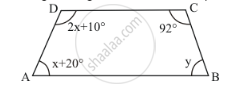
Complete the following statement by means of one of those given in brackets against each:
A line drawn from the mid-point of one side of a triangle .............. another side intersects the third side at its mid-point.
If the bisectors of two adjacent angles A and B of a quadrilateral ABCD intersect at a point O such that ∠C + ∠D = k ∠AOB, then find the value of k.
The consecutive sides of a quadrilateral have
In quadrilateral ABCD, side AB is parallel to side DC. If ∠A : ∠D = 1 : 2 and ∠C : ∠B = 4 : 5
(i) Calculate each angle of the quadrilateral.
(ii) Assign a special name to quadrilateral ABCD
The angles A, B, C and D of a quadrilateral are in the ratio 2 : 3 : 2 : 3. Show this quadrilateral is a parallelogram.
ΔPQR and ΔSQR are on the same base QR with P and S on opposite sides of line QR, such that area of ΔPQR is equal to the area of ΔSQR. Show that QR bisects PS.
The angles of a quadrilateral are in the ratio 2 : 4 : 5 : 7. Find all the angles
The number of obtuse angles in the following figure is ______.

The number of straight angles in the following figure is ______.

Using the information given, name the right angles in part of figure:
RT ⊥ ST

Draw a rough sketch of a quadrilateral KLMN. State two pairs of opposite sides.
