Advertisements
Advertisements
Question
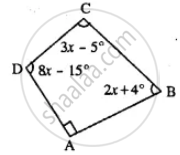
Use the information given in the following figure to find :
(i) x
(ii) ∠B and ∠C
Advertisements
Solution
∵ ∠A = 90° (Given)
∠B = (2x + 4°)
∠C = (3x - 5°)
∠D = (8x - 15°)
∠A + ∠B + ∠C + ∠D = 360°
90° + (2x + 4°) + (3x - 5°) + (8x - 15°) = 360°
90° + 2x + 4° + 3x - 5° + 8x - 15° = 360°
⇒ 74° + 13x = 360°
⇒ 13x = 360° - 74°
⇒ 13x = 286°
⇒ `x = 286/13`
⇒ x = 22°
∵ ∠B = 2x 4 = 2 × 22° + 4 = 48°
∠C = 3x - 5 = 3 × 22° - 5 = 61°
Hence (i) 22° (ii) ∠B = 48°, ∠C = 61°
RELATED QUESTIONS
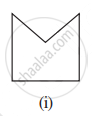
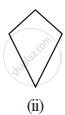
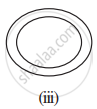
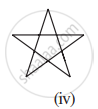
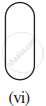
Given here are some figures:
 |
 |
 |
 |
 |
 |
 |
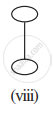 |
Classify each of them on the basis of the following:
- Simple curve
- Simple closed curve
- Polygon
- Convex polygon
- Concave polygon
In a quadrilateral, define of the following Sides.
In a quadrilateral, define of the following Diagonals .
In a quadrilateral, define of the following Adjacent angles .
Complete of the following, so as to make a true statement:
The sum of the angles of a quadrilateral is ......
Complete of the following, so as to make a true statement:
In a quadrilateral the point of intersection of the diagonals lies in .... of the quadrilateral.
In Fig. 16.19, ABCD is a quadrilateral.
How many pairs of opposite sides are there?
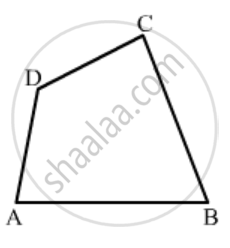
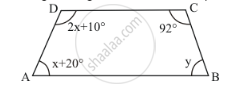
In the given figure, ABCD is a trapezium. Find the values of x and y.
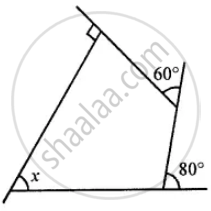
Use the following figure to find the value of x
In a quadrilateral ABCD, AO and BO are bisectors of angle A and angle B respectively. Show that:
∠AOB = (∠C + ∠D)
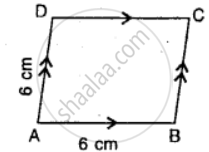
Write, giving reason, the name of the figure drawn alongside. Under what condition will this figure be a square.
Calculate the measure of each angle of a nonagon.
Which of the following is not true for a parallelogram?
Measures of the two angles between hour and minute hands of a clock at 9 O’ clock are ______.
In the following figure, if point A is shifted to point B along the ray PX such that PB = 2PA, then the measure of ∠BPY is ______.

A pair of opposite sides of a trapezium are ______.
Using the information given, name the right angles in part of figure:
BA ⊥ BD

What conclusion can be drawn from part of given figure, if DC is the bisector of ∠ADB, CA ⊥ DA and CB ⊥ DB?

Draw a rough sketch of a quadrilateral KLMN. State two pairs of opposite angles.
Which of the following is a key requirement for correctly naming a □ABCD?
