Advertisements
Advertisements
Question
If bisectors of ∠A and ∠B of a quadrilateral ABCD intersect each other at P, of ∠B and ∠C at Q, of ∠C and ∠D at R and of ∠D and ∠A at S, then PQRS is a ______.
Options
rectangle
rhombus
parallelogram
quadrilateral whose opposite angles are supplementary
Advertisements
Solution
If bisectors of ∠A and ∠B of a quadrilateral ABCD intersect each other at P, of ∠B and ∠C at Q, of ∠C and ∠D at R and of ∠D and ∠A at S, then PQRS is a quadrilateral whose opposite angles are supplementary
Explanation:
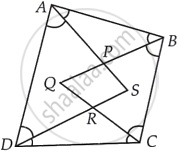
Sum of all angles of a quadrilateral is 360°
⇒ ∠A + ∠B + ∠C + ∠D = 360°
On dividing both sides by 2,
⇒ `1/2` (∠A + ∠B + ∠C + ∠D) = `1/2` × 360° = 180°
∵ AP, PB, RC and RD are bisectors of ∠A, ∠B, ∠C and ∠D
⇒ ∠PAB + ∠ABB + ∠RCD + ∠RDC = 180° ...(1)
Sum of all angles of a triangle is 180°
∴ ∠PAB + ∠APB + ∠ABP = 180°
⇒ ∠PAB + ∠ABP = 180° – ∠APB ...(2)
Similarly,
∴ ∠RDC + ∠RCD + ∠CRD = 180°
⇒ ∠RDC + ∠RCD = 180° – ∠CRD ...(3)
Putting (2) and (3) in (1),
180° – ∠APB + 180° – ∠CRD = 180°
⇒ 360° – ∠APB – ∠CRD = 180°
⇒ ∠APB + ∠CRD = 360° – 180°
⇒ ∠APB + ∠CRD = 180° ...(4)
Now,
∠SPQ = ∠APB ...[Vertically opposite angles]
∠SRQ = ∠DRC ...[Vertically opposite angles]
Putting in (4),
⇒ ∠SPQ + ∠SRQ = 180°
