Advertisements
Advertisements
प्रश्न
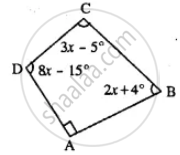
Use the information given in the following figure to find :
(i) x
(ii) ∠B and ∠C
Advertisements
उत्तर
∵ ∠A = 90° (Given)
∠B = (2x + 4°)
∠C = (3x - 5°)
∠D = (8x - 15°)
∠A + ∠B + ∠C + ∠D = 360°
90° + (2x + 4°) + (3x - 5°) + (8x - 15°) = 360°
90° + 2x + 4° + 3x - 5° + 8x - 15° = 360°
⇒ 74° + 13x = 360°
⇒ 13x = 360° - 74°
⇒ 13x = 286°
⇒ `x = 286/13`
⇒ x = 22°
∵ ∠B = 2x 4 = 2 × 22° + 4 = 48°
∠C = 3x - 5 = 3 × 22° - 5 = 61°
Hence (i) 22° (ii) ∠B = 48°, ∠C = 61°
संबंधित प्रश्न
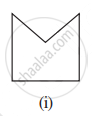
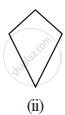
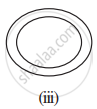
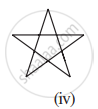
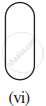
Given here are some figures:
 |
 |
 |
 |
 |
 |
 |
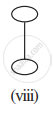 |
Classify each of them on the basis of the following:
- Simple curve
- Simple closed curve
- Polygon
- Convex polygon
- Concave polygon
What is the sum of the measures of the angels of a convex quadrilateral? Will this property hold if the quadrilateral is not convex? (Make a non-convex quadrilateral and try!)
In a quadrilateral, define of the following Angles .
Complete of the following, so as to make a true statement:
The measure of each angle of a convex quadrilateral is ..... 180°.
The three angles of a quadrilateral are respectively equal to 110°, 50° and 40°. Find its fourth angle.
If the bisectors of two adjacent angles A and B of a quadrilateral ABCD intersect at a point O such that ∠C + ∠D = k ∠AOB, then find the value of k.
Two angles of a quadrilateral are 89° and 113°. If the other two angles are equal; find the equal angles.
Two angles of a quadrilateral are 68° and 76°. If the other two angles are in the ratio 5 : 7; find the measure of each of them.
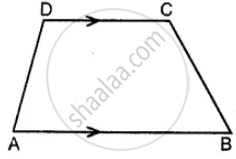
The following figure shows a quadrilateral in which sides AB and DC are parallel. If ∠A : ∠D = 4 : 5, ∠B = (3x – 15)° and ∠C = (4x + 20)°, find each angle of the quadrilateral ABCD.
In a quadrilateral ABCD, AO and BO are bisectors of angle A and angle B respectively. Show that:
∠AOB = (∠C + ∠D)
In parallelogram ABCD, its diagonals intersect at point O. If OA = 6 cm and OB = 7.5 cm, find the length of AC and BD.
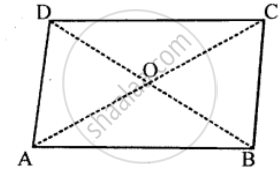
Write two conditions that will make the adjoining figure a square.

One angle of a pentagon is 160° and the rest are all equal angles. Find the measure of the equal angles.
In the quadrilateral ABCD, AB = BC and AD = DC Measure of ∠BCD is
Three angles of a quadrilateral are 75º, 90º and 75º. The fourth angle is ______.
The common part between the two angles BAC and DAB in the following figure is ______.

In the following figure, name any four angles that appear to be acute angles.

Draw a rough sketch of a quadrilateral KLMN. State two pairs of opposite sides.
