Advertisements
Advertisements
प्रश्न
The measure of angles of a hexagon are x°, (x − 5)°, (x − 5)°, (2x − 5)°, (2x − 5)°, (2x + 20)°. Find the value of x.
Advertisements
उत्तर
\[\text{ Since the sum of all the angles of a hexagon is } 720° , \text{ we get } : \]
\[x° + \left( x - 5 \right)° + \left( x - 5 \right)° + \left( 2x - 5 \right)° + \left( 2x - 5 \right)° + \left( 2x + 20 \right)° = 720°\]
\[ \Rightarrow x° + x° - 5° + x°- 5°+ 2x - 5°+ 2x - 5°+ 2x + 20°= 720° \]
\[ \Rightarrow 9x - 20° + 20° = 720° \]
\[ \Rightarrow 9x = 720° \]
\[ \therefore x = 80\]
संबंधित प्रश्न
How many diagonals does following have?
A triangle
The sides of a quadrilateral are produced in order. What is the sum of the four exterior angles?
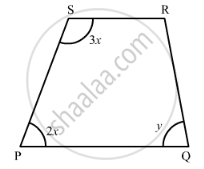
In the given figure, PQRS is an isosceles trapezium. Find x and y.
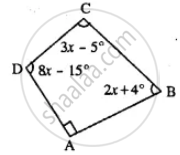
Use the information given in the following figure to find :
(i) x
(ii) ∠B and ∠C
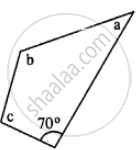
In the given figure : ∠b = 2a + 15 and ∠c = 3a + 5; find the values of b and c.
The angles of a pentagon are x°, (x - 10)°, (x + 20)°, (2x - 44)° and (2x - 70)°. Find the angles.
The number of common points in the two angles marked in the following figure is ______.

Using the information given, name the right angles in part of figure:
RS ⊥ RW

Using the information given, name the right angles in part of figure:
AC ⊥ CD

Can we have two obtuse angles whose sum is a reflex angle? Why or why not?
