Advertisements
Advertisements
प्रश्न
The measure of angles of a hexagon are x°, (x − 5)°, (x − 5)°, (2x − 5)°, (2x − 5)°, (2x + 20)°. Find the value of x.
Advertisements
उत्तर
\[\text{ Since the sum of all the angles of a hexagon is } 720° , \text{ we get } : \]
\[x° + \left( x - 5 \right)° + \left( x - 5 \right)° + \left( 2x - 5 \right)° + \left( 2x - 5 \right)° + \left( 2x + 20 \right)° = 720°\]
\[ \Rightarrow x° + x° - 5° + x°- 5°+ 2x - 5°+ 2x - 5°+ 2x + 20°= 720° \]
\[ \Rightarrow 9x - 20° + 20° = 720° \]
\[ \Rightarrow 9x = 720° \]
\[ \therefore x = 80\]
संबंधित प्रश्न
ABCD is a parallelogram, AD is produced to E so that DE = DC and EC produced meets AB produced in F. Prove that BF = BC.
Complete of the following, so as to make a true statement:
In a quadrilateral the point of intersection of the diagonals lies in .... of the quadrilateral.
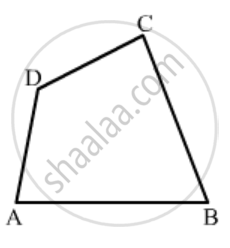
In Fig. 16.19, ABCD is a quadrilateral.
Name a pair of opposite sides.
In a convex hexagon, prove that the sum of all interior angle is equal to twice the sum of its exterior angles formed by producing the sides in the same order.
Complete the following statement by means of one of those given in brackets against each:
If one pair of opposite sides are equal and parallel, then the figure is ........................
Complete the following statement by means of one of those given in brackets against each:
If opposite angles of a quadrilateral are equal, then it is necessarily a ....................
Angle A of an isosceles trapezium ABCD is 115°; find the angles B, C and D.
The angles of a pentagon are x°, (x - 10)°, (x + 20)°, (2x - 44)° and (2x - 70)°. Find the angles.
Measures of the two angles between hour and minute hands of a clock at 9 O’ clock are ______.
If the sum of two angles is greater than 180°, then which of the following is not possible for the two angles?
