Advertisements
Advertisements
प्रश्न
Angles of a quadrilateral are (4x)°, 5(x+2)°, (7x – 20)° and 6(x+3)°. Find :
(i) the value of x.
(ii) each angle of the quadrilateral.
Advertisements
उत्तर
Angles of quadrilateral are,
(4x)°, 5(x+2)°, (7x – 20)° and 6(x+3)°
∴ 4x + 5(x + 2) + (7x - 20) + 6(x + 3) = 360°
4x + 5x + 10 + 7x - 20 + 6x + 18 = 360°
22x + 8 = 360°
22x = 360° - 8°
22x = 352°
x = 16°
Hence angles are,
(4x)° = (4 × 16)° = 64°
5(x + 2)° = 5(16 + 2)° = 90°
(7x - 20)° = (7 × 16 - 20)° = 92°
6(x + 3)° = 6(16 + 3) = 114°
संबंधित प्रश्न
In a quadrilateral, define of the following Sides.
In a quadrilateral, define of the following Diagonals .
Complete of the following, so as to make a true statement:
A quadrilateral has .... diagonals.
Complete of the following, so as to make a true statement:
The number of pairs of adjacent angles of a quadrilateral is .......
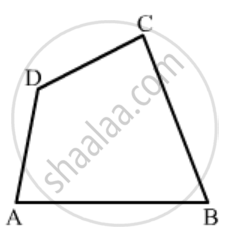
In Fig. 16.19, ABCD is a quadrilateral.
How many pairs of adjacent sides are there?
The angles of a quadrilateral are 110°, 72°, 55° and x°. Find the value of x.
Three angles of a quadrilateral are equal. Fourth angle is of measure 150°. What is the measure of equal angles.
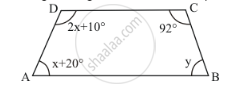
In the given figure, ABCD is a trapezium. Find the values of x and y.
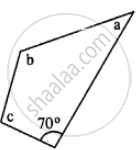
In the given figure : ∠b = 2a + 15 and ∠c = 3a + 5; find the values of b and c.
The following figure shows a quadrilateral in which sides AB and DC are parallel. If ∠A : ∠D = 4 : 5, ∠B = (3x – 15)° and ∠C = (4x + 20)°, find each angle of the quadrilateral ABCD.
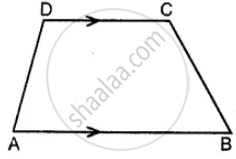
In a trapezium ABCD, side AB is parallel to side DC. If ∠A = 78° and ∠C = 120. find angles B and D.
Two diagonals of an isosceles trapezium are x cm and (3x – 8) cm. Find the value of x.
D and E are the mid-points of the sides AB and AC respectively of ∆ABC. DE is produced to F. To prove that CF is equal and parallel to DA, we need an additional information which is ______.
Both the pairs of opposite angles of a quadrilateral are equal and supplementary. Find the measure of each angle.
Measures of the two angles between hour and minute hands of a clock at 9 O’ clock are ______.
Draw a rough sketch of a quadrilateral KLMN. State two pairs of opposite angles.
Investigate :
Use strips and fasteners to make a triangle and a quadrilateral.
Try to push inward at any one vertex of the triangle. Do the same to the quadrilateral. Is the triangle distorted? Is the quadrilateral distorted? Is the triangle rigid?
Why is it that structures like electric towers make use of triangular shapes and not quadrilaterals?
