Advertisements
Advertisements
प्रश्न
In a quadrilateral ABCD, AO and BO are bisectors of angle A and angle B respectively. Show that:
∠AOB = (∠C + ∠D)
Advertisements
उत्तर
In a quadrilateral ABCD, AO and BO are the bisectors of ∠A and ∠B, respectively. We need to prove that:
∠AOB = ∠C + ∠D.
The sum of the interior angles of a quadrilateral is: ∠A + ∠B + ∠C + ∠D = 360∘.
Since AO and BO are the bisectors of ∠A\ and ∠B\, we can express: `angleAOB=(angleA)/2+(angleB)/2`
From the sum of the interior angles of the quadrilateral, rearrange to find ∠A+∠B
∠A + ∠B = 360∘ − (∠C + ∠D).
Now substitute ∠A+∠B into the expression for ∠AOB:
`angleAOB= (angleA)/2+(angleB)/2=(angleA+angleB)/2`
Replace ∠A + ∠B with 360∘ − (∠C + ∠D)
`angleAOB=(360°-(angleC+angleD))/2`
Simplify: `angleAOB = 180°-(angleC+angleD)/2`
∠AOB = ∠C + ∠D.
APPEARS IN
संबंधित प्रश्न
How many diagonals does following have?
A convex quadrilateral
In a quadrilateral, define of the following Angles .
Complete of the following, so as to make a true statement:
The sum of the angles of a quiadrilateral is .... right angles.
In Fig. 16.20, find the measure of ∠MPN.
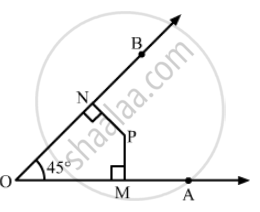
Complete the following statement by means of one of those given in brackets against each:
If in a quadrilateral only one pair of opposite sides are parallel, the quadrilateral is ................
Complete the following statement by means of one of those given in brackets against each:
A line drawn from the mid-point of one side of a triangle .............. another side intersects the third side at its mid-point.
In an isosceles trapezium one pair of opposite sides are _____ to each Other and the other pair of opposite sides are _____ to each other.
In the figure, PQRS and PTVS are two cyclic quadrilaterals, If ∠QRS = 100°, then ∠TVS =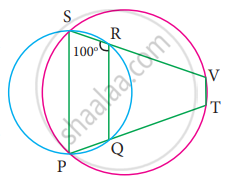
Number of angles less than 180° in the following figure is ______ and their names are ______.

The number of right angles in a straight angle is ______ and that in a complete angle is ______.
