Advertisements
Advertisements
प्रश्न
Two opposite angles of a parallelogram are 100° each. Find each of the other two opposite angles.
Advertisements
उत्तर
Given: Two opposite angles of a parallelogram are 100° each.
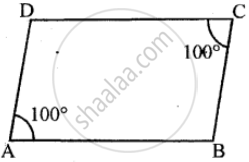
∵ Adjacent angles of a parallelogram are supplementary,
∴ ∠A + ∠B = 180°
⇒ 100° + ∠B = 180°
⇒ ∠B = 180° – 100°
⇒ ∠B = 80°
Also, opposite angles of a parallelogram are equal
∴∠D = ∠B = 80°
∴∠B = ∠D = 80°
APPEARS IN
संबंधित प्रश्न
In a quadrilateral, define of the following Sides.
The four angles of a quadrilateral are as 3 : 5 : 7 : 9. Find the angles.
If the sum of the two angles of a quadrilateral is 180°. What is the sum of the remaining two angles?
The sides of a quadrilateral are produced in order. What is the sum of the four exterior angles?
Which of the following quadrilateral is not a rhombus?
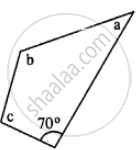
In the given figure : ∠b = 2a + 15 and ∠c = 3a + 5; find the values of b and c.
ABCD is a rhombus such that ∠ACB = 40º. Then ∠ADB is ______.
In the following figure, name any two angles that appear to be obtuse angles.

In the following figure, What is BD – DE?

Can we have two obtuse angles whose sum is a reflex angle? Why or why not?
