Advertisements
Advertisements
प्रश्न
Two opposite angles of a parallelogram are 100° each. Find each of the other two opposite angles.
Advertisements
उत्तर
Given: Two opposite angles of a parallelogram are 100° each.
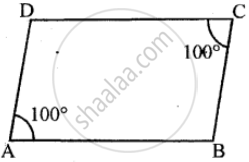
∵ Adjacent angles of a parallelogram are supplementary,
∴ ∠A + ∠B = 180°
⇒ 100° + ∠B = 180°
⇒ ∠B = 180° – 100°
⇒ ∠B = 80°
Also, opposite angles of a parallelogram are equal
∴∠D = ∠B = 80°
∴∠B = ∠D = 80°
APPEARS IN
संबंधित प्रश्न
How many diagonals does following have?
A convex quadrilateral
In a quadrilateral, define of the following Opposite angles .
If the sum of the two angles of a quadrilateral is 180°. What is the sum of the remaining two angles?
Observe the figure below and find out their name.

In a pentagon ABCDE, AB || ED and ∠B = 140°, ∠C = 2x° and ∠D = 3x°. Find ∠C and ∠D
ABCD is a rhombus such that ∠ACB = 40º. Then ∠ADB is ______.
If a bicycle wheel has 48 spokes, then the angle between a pair of two consecutive spokes is ______.
In the following figure, ∠XYZ cannot be written as ______.

Using the information given, name the right angles in part of figure:
AE ⊥ CE

Using the information given, name the right angles in part of figure:
OP ⊥ AB

