Advertisements
Advertisements
प्रश्न
Two adjacent angles of a parallelogram are 70° and 110° respectively. Find the other two angles of it.
Advertisements
उत्तर
Given two adjacent angles of a parallelogram are 70° and 110° respectively.
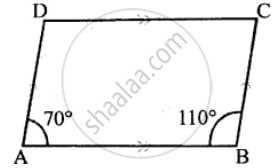
Since, we know that opposite angles of a parallelogram are equal
∴∠C = ∠A = 70° and ∠D = ∠B = 110°
APPEARS IN
संबंधित प्रश्न
In a quadrilateral, define of the following Adjacent angles .
Complete of the following, so as to make a true statement:
The number of pairs of adjacent angles of a quadrilateral is .......
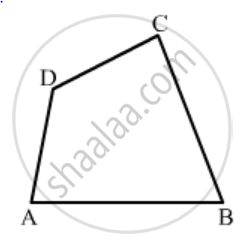
In Fig. 16.19, ABCD is a quadrilateral.
How many pairs of opposite angles are there?
A quadrilateral has all its four angles of the same measure. What is the measure of each?
Two angles of a quadrilateral are of measure 65° and the other two angles are equal. What is the measure of each of these two angles?
Two opposite angles of a parallelogram are 100° each. Find each of the other two opposite angles.
In a parallelogram ABCD, its diagonals AC and BD intersect each other at point O.

If AC = 12 cm and BD = 9 cm ; find; lengths of OA and OD.
In a quadrilateral ABCD, ∠A = 72° and ∠C is the supplementary of ∠A. The other two angles are 2x – 10 and x + 4. Find the value of x and the measure of all the angles
ABCD is a quadrilateral in which AB || DC and AD = BC. Prove that ∠A = ∠B and ∠C = ∠D.
If the sum of two angles is greater than 180°, then which of the following is not possible for the two angles?
