Advertisements
Advertisements
प्रश्न
The angles A, B, C and D of a quadrilateral are in the ratio 2 : 3 : 2 : 3. Show this quadrilateral is a parallelogram.
Advertisements
उत्तर १
Given, Angles of a quadrilateral are in the ratio 2 : 3 : 2 : 3
i.e. A : B : C : D are in the ratio
2 : 3 : 2 : 3
To prove: Quadrilateral ABCD is a parallelogram
Proof: Let us take ∠A = 2x, ∠B = 3x, ∠C = 2x and ∠D = 3x
We know, that the sum of interior angles of a quadrilateral = 360°
⇒ ∠A + ∠B + ∠C + ∠D = 360°
⇒ 2x + 3x + 2x + 3x = 360°
⇒ 10x = 360°
⇒ x = `360^circ/10 = 36^circ`
∴ ∠A = ∠C = 2x = 2 × 360° = 72°
∠B = ∠D = 3x = 3 × 36° = 360°
Now, A quadrilateral ABCD is considered as a parallelogram.
(i) When opposite angles are equal,
i.e. ∠A = ∠C = 72° and ∠B = ∠D = 108°
(ii) When adjacent angles are supplementary
i.e. ∠A + ∠B = 180°
and ∠C = ∠D = 180°
⇒ 72° + 108° and 72° + 108° = 180°
⇒ 180° = 180° and 180° = 180°
Since quadrilateral ABCD fulfills the conditions.
∴ Quadrilateral ABCD is a parallelogram.
उत्तर २
The sum of all angles in a quadrilateral is 360∘. Let the angles of the quadrilateral be 2x, 3x, 2x, and 3x.
Using the sum of the angles:
2x + 3x + 2x + 3x = 360∘.
Simplify: 10x = 360∘
x = 36∘
Substitute x = 36∘ into the expressions for the angles:
- 2x = 2 × 36 = 72∘
- 3x = 3 × 36 = 108∘
Thus, the angles are: 72∘, 108∘, 72∘, 108∘
In a parallelogram, opposite angles are equal. Here:
- One pair of opposite angles: 72∘, 72∘,
- Another pair of opposite angles: 108∘, 108∘
Since opposite angles are equal, the quadrilateral satisfies the property of a parallelogram.
The given quadrilateral is a parallelogram because its opposite angles are equal
APPEARS IN
संबंधित प्रश्न
Complete of the following, so as to make a true statement:
In a quadrilateral the point of intersection of the diagonals lies in .... of the quadrilateral.
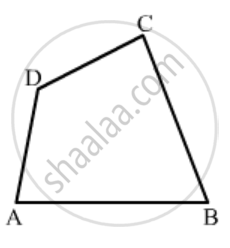
In Fig. 16.19, ABCD is a quadrilateral.
Name a pair of opposite sides.
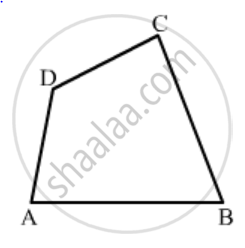
In Fig. 16.19, ABCD is a quadrilateral.
Name a pair of adjacent angles.
The four angles of a quadrilateral are as 3 : 5 : 7 : 9. Find the angles.
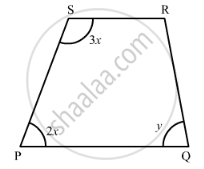
In the given figure, PQRS is an isosceles trapezium. Find x and y.
From the following figure find;
- x
- ∠ABC
- ∠ACD
The number of straight angles in the following figure is ______.

Using the information given, name the right angles in part of figure:
AE ⊥ CE

What conclusion can be drawn from part of given figure, if DB is the bisector of ∠ADC?

How many points are required to form a quadrilateral?
