Advertisements
Advertisements
प्रश्न
Two angles of a quadrilateral are of measure 65° and the other two angles are equal. What is the measure of each of these two angles?
Advertisements
उत्तर
\[ \text{ Let x be the measure of each angle } . \]
\[\text{ Since, the sum of all the angles of a quadrilateral is } 360 °, \text{ we have: } \]
\[65° + 65° + x° + x° = 360° \]
\[ \Rightarrow 2x° + 130°= 360° \]
\[ \Rightarrow 2x° = 230° \]
\[ \Rightarrow x° = 115°\]
\[ \therefore \text{ The measure of each angle is } 115° .\]
संबंधित प्रश्न
ABCD is a parallelogram, AD is produced to E so that DE = DC and EC produced meets AB produced in F. Prove that BF = BC.
Complete of the following, so as to make a true statement:
A quadrilateral has ....... sides.
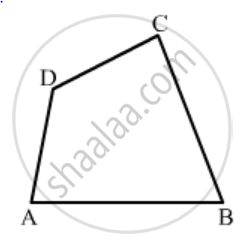
In Fig. 16.19, ABCD is a quadrilateral.
How many pairs of opposite angles are there?
In a quadrilateral ABCD, the angles A, B, C and D are in the ratio 1 : 2 : 4 : 5. Find the measure of each angle of the quadrilateral.
Determine the number of sides of a polygon whose exterior and interior angles are in the ratio 1 : 5.
The angles A, B, C and D of a quadrilateral are in the ratio 2 : 3 : 2 : 3. Show this quadrilateral is a parallelogram.
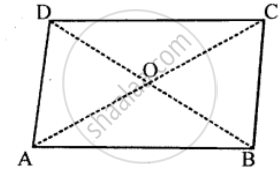
In parallelogram ABCD, its diagonals intersect at point O. If OA = 6 cm and OB = 7.5 cm, find the length of AC and BD.
The angles of a pentagon are x°, (x - 10)°, (x + 20)°, (2x - 44)° and (2x - 70)°. Find the angles.
Using the information given, name the right angles in part of figure:
RS ⊥ RW

What conclusion can be drawn from part of given figure, if DB is the bisector of ∠ADC?

