Advertisements
Advertisements
प्रश्न
What is the sum of the measures of the angels of a convex quadrilateral? Will this property hold if the quadrilateral is not convex? (Make a non-convex quadrilateral and try!)
Advertisements
उत्तर
The sum of the measures of the angles of a convex quadrilateral is 360° as a convex quadrilateral is made of two triangles.
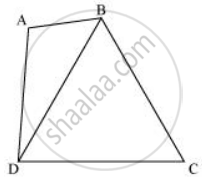
Here, ABCD is a convex quadrilateral, made of two triangles ΔABD and ΔBCD. Therefore, the sum of all the interior angles of this quadrilateral will be same as the sum of all the interior angles of these two triangles i.e., 180º + 180º = 360º
Yes, this property also holds true for a quadrilateral which is not convex. This is because any quadrilateral can be divided into two triangles.
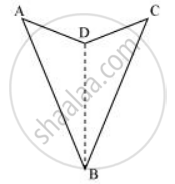
Here again, ABCD is a concave quadrilateral, made of two triangles ΔABD and ΔBCD. Therefore, sum of all the interior angles of this quadrilateral will also be 180º + 180º = 360º
संबंधित प्रश्न
How many diagonals does following have?
A convex quadrilateral
Complete of the following, so as to make a true statement:
A diagonal of a quadrilateral is a line segment that joins two ...... vertices of the quadrilateral.
Three angles of a quadrilateral are equal. Fourth angle is of measure 150°. What is the measure of equal angles.
Complete the following statement by means of one of those given in brackets against each:
A line drawn from the mid-point of one side of a triangle .............. another side intersects the third side at its mid-point.
Complete the following statement by means of one of those given in brackets against each:
If opposite angles of a quadrilateral are equal, then it is necessarily a ....................
In ΔABC, E is the mid-point of median AD such that BE produced meets AC at F. IF AC = 10.5 cm, then AF =
In a trapezium ABCD, side AB is parallel to side DC. If ∠A = x° and ∠D = (3x – 20)°; find the value of x.
In a quadrilateral ABCD, ∠A = 72° and ∠C is the supplementary of ∠A. The other two angles are 2x – 10 and x + 4. Find the value of x and the measure of all the angles
If APB and CQD are two parallel lines, then the bisectors of the angles APQ, BPQ, CQP and PQD form ______.
A quadrilateral can have all four angles as obtuse.
