Advertisements
Advertisements
Question
What is the sum of the measures of the angels of a convex quadrilateral? Will this property hold if the quadrilateral is not convex? (Make a non-convex quadrilateral and try!)
Advertisements
Solution
The sum of the measures of the angles of a convex quadrilateral is 360° as a convex quadrilateral is made of two triangles.
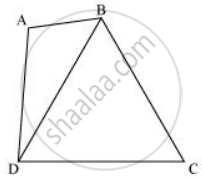
Here, ABCD is a convex quadrilateral, made of two triangles ΔABD and ΔBCD. Therefore, the sum of all the interior angles of this quadrilateral will be same as the sum of all the interior angles of these two triangles i.e., 180º + 180º = 360º
Yes, this property also holds true for a quadrilateral which is not convex. This is because any quadrilateral can be divided into two triangles.
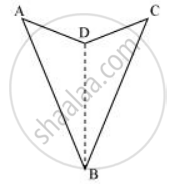
Here again, ABCD is a concave quadrilateral, made of two triangles ΔABD and ΔBCD. Therefore, sum of all the interior angles of this quadrilateral will also be 180º + 180º = 360º
RELATED QUESTIONS
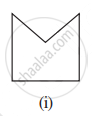
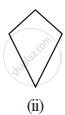
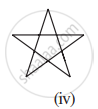
Given here are some figures:
 |
 |
 |
 |
 |
 |
 |
 |
Classify each of them on the basis of the following:
- Simple curve
- Simple closed curve
- Polygon
- Convex polygon
- Concave polygon
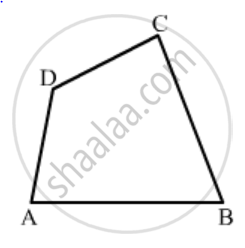
In Fig. 16.19, ABCD is a quadrilateral.
Name a pair of adjacent angles.
Angles of a quadrilateral are (4x)°, 5(x+2)°, (7x – 20)° and 6(x+3)°. Find :
(i) the value of x.
(ii) each angle of the quadrilateral.
In a trapezium ABCD, side AB is parallel to side DC. If ∠A = 78° and ∠C = 120. find angles B and D.
ΔPQR and ΔSQR are on the same base QR with P and S on opposite sides of line QR, such that area of ΔPQR is equal to the area of ΔSQR. Show that QR bisects PS.
In quadrilateral HOPE, the pairs of opposite sides are ______.
In the following figure,

∠AOD is a/an ______ angle
The number of right angles in a straight angle is ______ and that in a complete angle is ______.
The common part between the two angles BAC and DAB in the following figure is ______.

Using the information given, name the right angles in part of figure:
AC ⊥ CD

