Advertisements
Advertisements
Question
Two opposite angles of a parallelogram are 100° each. Find each of the other two opposite angles.
Advertisements
Solution
Given: Two opposite angles of a parallelogram are 100° each.
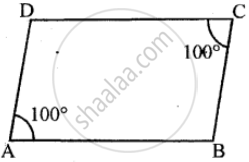
∵ Adjacent angles of a parallelogram are supplementary,
∴ ∠A + ∠B = 180°
⇒ 100° + ∠B = 180°
⇒ ∠B = 180° – 100°
⇒ ∠B = 80°
Also, opposite angles of a parallelogram are equal
∴∠D = ∠B = 80°
∴∠B = ∠D = 80°
APPEARS IN
RELATED QUESTIONS
The perimeter of a parallelogram is 22 cm . If the longer side measures 6.5 cm what is the measure of the shorter side?
Complete of the following, so as to make a true statement:
A quadrilateral has .... diagonals.
A quadrilateral has three acute angles each measures 80°. What is the measure of the fourth angle?
Complete the following statement by means of one of those given in brackets against each:
If both pairs of opposite sides of a quadrilateral are equal, then it is necessarily a ...............
If ABCD is a rectangle with ∠BAC = 32°, find the measure of ∠DBC.
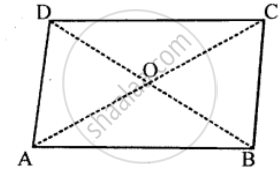
In parallelogram ABCD, its diagonals intersect at point O. If OA = 6 cm and OB = 7.5 cm, find the length of AC and BD.
In parallelogram ABCD, ∠A = 90°
(i) What is the measure of angle B.
(ii) Write the special name of the parallelogram.
The common part between the two angles BAC and DAB in the following figure is ______.

In the following figure, name any four angles that appear to be acute angles.

In the following figure, What is AC – EC?

